Accession Number
1945.8.420
Medium
hand-colored engraving and aquatint on Whatman wove paper
Dimensions
N/A
Classification
Credit Line
Gift of Mrs. Walter B. James
Tags
Print Neoclassical & Romantic (1751–1850) Engraving Paper American
Background & Context
Background Story
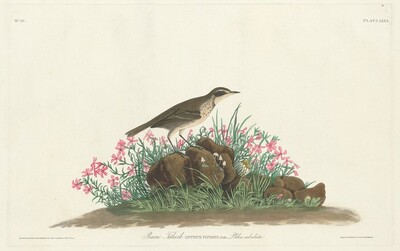
Prairie Starling from 1838 is a plate from John James Audubon's Birds of America, engraved by Robert Havell Jr. after Audubon's original watercolor. The Birds of America (1827-1838) is one of the most important works in the history of natural history illustration, containing 435 hand-colored engravings of over 700 species of American birds at life size. Robert Havell Jr. (1793-1878) was the engraver who translated Audubon's watercolors into the aquatint engravings that made the Birds of America famous, and his skill as an engraver was essential to the project's success. The 1838 date places this in the final year of the project.
Cultural Impact
Prairie Starling is important in the history of natural history illustration because it demonstrates the collaborative process between Audubon and Havell that produced the most important work in the history of American ornithological illustration. The Birds of America—combining Audubon's revolutionary approach to depicting birds in their natural habitat with Havell's masterful engraving—represents the highest level of accomplishment in natural history illustration, and the 1838 plate shows this collaborative process at its most accomplished in the final year of the project.
Why It Matters
Prairie Starling is from Audubon's Birds of America, engraved by Robert Havell in the final year of the most important work in the history of American ornithological illustration. The 1838 plate demonstrates the collaborative process between Audubon's revolutionary watercolors and Havell's masterful engraving that produced the highest level of accomplishment in natural history illustration.