Provenance
Alfred de Knyff [1819-1885], Paris, by 1878.[1] Erwin Davis, New York;[2] sold 1 May 1893 to (Durand-Ruel et Cie., New York, stock no. 1070, as _Les Pêcheurs d'anguilles_); sold that same day to Henry Osborn Havemeyer [1847-1907] and his wife, née Louisine Waldron Elder [1855-1929], New York; their daughter, Mrs. P.H.B. Frelinghuysen, née Adaline Havemeyer [1884-1963], Morristown, New Jersey; gift 1943 to NGA.
[1] Lent by de Knyff to _Exposition universelle_, Paris, 1878, no. 204.
[2] Provenance between de Knyff and Havemeyers is according to _Splendid Legacy: The Havemeyer Collection_, Exh. cat., The Metropolitan Museum of Art, New York, 1993: 309.
Accession Number
1943.15.1
Medium
oil on canvas
Dimensions
overall: 60.5 x 81.5 cm (23 13/16 x 32 1/16 in.) | framed: 80 x 106 x 7 cm (31 1/2 x 41 3/4 x 2 3/4 in.)
Classification
Painting
Credit Line
Gift of Mr. and Mrs. P.H.B. Frelinghuysen in memory of her father and mother, Mr. and Mrs. H.O. Havemeyer
Tags
Painting Impressionist & Modern (1851–1900) Oil Painting Canvas French
Background & Context
Background Story
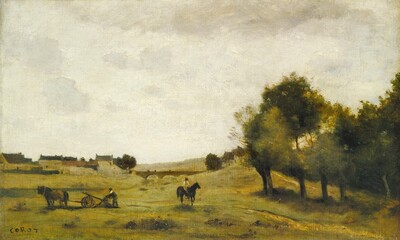
The Eel Gatherers (1860/1865) depicts a traditional rural occupation—gathering eels from rivers and streams—that was common in 19th-century France but has since largely disappeared. The eel gatherers, working in shallow water with specialized traps and nets, represent the kind of rural labor that Corot documented throughout his career. The 1860-65 date places this during Corot's middle-to-late period, when his landscape style was reaching its mature synthesis of observation and atmosphere. Corot's treatment of the eel gatherers combines genre painting—the documentation of rural occupations—with the landscape painting that was his primary practice. The figures wading in the water, their activities integrated into the river landscape, represent Corot's characteristic approach to the human figure in landscape: present, active, but subordinate to the overall atmospheric effect. The painting also documents a traditional rural practice that was already declining in the 1860s—river eel gathering required knowledge and techniques that were passed through generations, and as rural populations moved to cities, these traditions eroded. Corot's painting preserves this vanishing practice with the atmospheric sensitivity that gives his rural subjects their distinctive poetry.
Cultural Impact
Corot's rural genre paintings influenced how traditional French agricultural and fishing practices were represented in art, documenting occupations that were disappearing even as he painted them. The paintings influenced later Naturalist painters who similarly sought to represent rural labor with both accuracy and sympathy. The eel gatherers subject influenced how river ecology was understood in visual art, connecting human activity to aquatic environments.
Why It Matters
This painting matters because it documents a traditional rural occupation that has since largely disappeared—one of the many traditional practices that 19th-century modernization was erasing. Corot's painting preserves the eel gatherers' knowledge and technique with the atmospheric poetry that gives vanishing practices the dignity of artistic representation.