Provenance
Descended in the family of the sitter. Mrs. William McElroy, New York and East Haddam, Connecticut. Sold to (Frederick W. and Jean C. Fuessenich, Torrington, Connecticut); by whom sold in 1951 to Edgar William and Bernice Chrysler Garbisch; gift to NGA, 1956.
Accession Number
1956.13.9
Medium
oil on canvas
Dimensions
overall: 91.8 x 72.4 cm (36 1/8 x 28 1/2 in.) | framed: 98.4 x 78.7 x 5 cm (38 3/4 x 31 x 1 15/16 in.)
Classification
Painting
Credit Line
Gift of Edgar William and Bernice Chrysler Garbisch
Tags
Painting Neoclassical & Romantic (1751–1850) Oil Painting Canvas American
Background & Context
Background Story
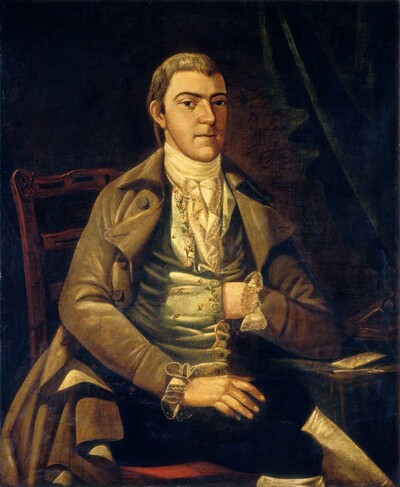
This portrait of a young woman from New Haven, Connecticut, exemplifies the distinctive style of American folk portraiture at the end of the 18th century. The unknown painter — likely an itinerant artist working in the Connecticut region — produced a likeness that is more direct than sophisticated: the sitter's features are recorded with flat, frontal precision, her dress rendered with decorative patterning rather than atmospheric modeling, and the overall effect is one of earnest clarity rather than cosmopolitan elegance. The painting captures a specific moment in American culture when portraiture was moving beyond the preserve of the wealthy elite.
Cultural Impact
American 18th-century folk portraits occupy a unique position in art history. They are not naive imitations of European styles but genuine expressions of a democratic visual culture where ordinary citizens wanted likenesses that recorded their presence with the same insistence that aristocratic portraits recorded status. The flat, direct style was not a failure of skill but an assertion of identity: this person existed, looked like this, and mattered.
Why It Matters
Miss Daggett is a document of early American visual culture at its most direct and democratic. The painting's lack of academic refinement is not a deficiency but a statement — a declaration that portraiture belongs to everyone, not just the European-trained elite.