Provenance
The sitter's grandson, Rev. William S. Boardman [b. 1838], New York.[1] The sitter's great-grandniece, Josephine Porter Boardman Crane [Mrs. Winthrop Murray Crane, 1873-1972], New York and Woods Hole, Massachusetts, by 1935;[2] gift 1948 to NGA.
[1] The portrait presumably was inherited first by the sitter's son Frederic William Henry Boardman [1804-1882], New York City and New Hamburg, New York, and then by his son William S. Boardman. On these relationships see Charlotte Goldthwaite, _Boardman Genealogy 1525-1895_, (Hartford, 1895), 331-332, 408.
[2] Mrs. Crane, the great-granddaughter of Elijah Boardman, the sitter's brother, owned the portrait by 1935, when she lent it to the exhibition at Yale University. Carl Boardman Cobb recalled that Mrs. Crane, his great-aunt, said she bought the painting from another member of the family (telephone interview, 8 January 1990). For Mrs. Crane's dates see Goldthwaite 1895, 545, and the _National Cyclopedia of American Biography_ 57 (Clifton, New Jersey, 1977), 720.
Accession Number
1948.8.1
Medium
oil on canvas
Dimensions
overall: 207.4 x 140.4 cm (81 5/8 x 55 1/4 in.) | framed: 228 x 160 x 10.2 cm (89 3/4 x 63 x 4 in.)
Classification
Painting
Credit Line
Gift of Mrs. W. Murray Crane
Tags
Painting Neoclassical & Romantic (1751–1850) Oil Painting Canvas American
Background & Context
Background Story
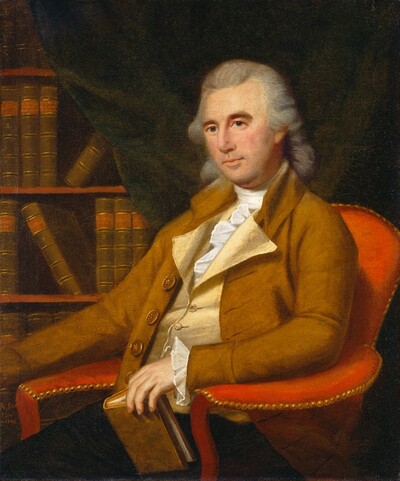
Ralph Earl (1751-1801) was an American portrait painter known for his portraits of Connecticut's elite in the straightforward manner that distinguishes the best American portraiture of the Federal period. Daniel Boardman from 1789 depicts the Connecticut minister in the precise, straightforward manner that Earl brought to American portraiture after his years of study in London. The 1789 date places this in Earl's most productive American period, when he was producing the portraits of Connecticut's elite that are his most accomplished works, and the portrait of a minister shows Earl's ability to bring the same straightforward dignity to clerical subjects that he brought to secular ones.
Cultural Impact
Daniel Boardman is important in the history of American portraiture because it demonstrates the straightforward manner that Earl brought to American portraiture after his years of study in London. The portrait of a Connecticut minister shows that Earl's straightforward dignity could serve clerical as well as secular subjects, creating a type of American portraiture that was both dignified and democratic in its straightforward treatment of different social classes.
Why It Matters
Daniel Boardman is Earl's Federal period portraiture at its straightforward best: a Connecticut minister rendered with the precise, dignified manner that Earl brought to American portraiture after his London years. The 1789 portrait shows that Earl's straightforward dignity could serve clerical as well as secular subjects.