Provenance
Alexander Young, London.[1] (M. Knoedler & Co., New York); sold 1908 to R. Horace Gallatin [1871-1948], New York; bequest 1949 to NGA.
[1]According to note on accession card in NGA curatorial records.
Accession Number
1949.1.7
Medium
oil on canvas
Dimensions
overall: 50.2 x 61.6 cm (19 3/4 x 24 1/4 in.) | framed: 80.9 x 92.4 x 9.5 cm (31 7/8 x 36 3/8 x 3 3/4 in.)
Classification
Painting
Credit Line
Gift of R. Horace Gallatin
Tags
Painting Impressionist & Modern (1851–1900) Oil Painting Canvas French
Background & Context
Background Story
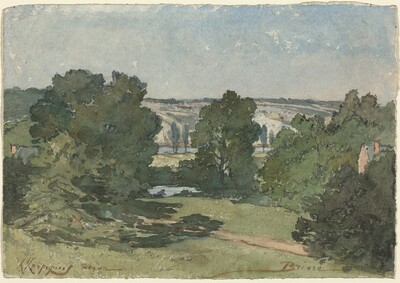
This 1898 Landscape is a late work by an artist who had been painting the French landscape for over fifty years. The composition is characteristic of Harpignies' mature style: trees framing a view, a river or valley receding into the distance, and a sky that occupies a significant portion of the canvas. The brushwork is broad and confident, the color is tonally unified, and the overall effect is one of measured contemplation rather than dramatic effect. Harpignies' late landscapes are among his most achieved works, demonstrating the simplification that comes with mastery — the ability to say more with less.
Cultural Impact
By 1898, Harpignies was one of the last survivors of the generation that had defined French landscape painting in the mid-19th century, and his late landscapes carry the weight of the entire Barbizon tradition. The Impressionists had long since surpassed him in popular esteem, but his continued production — and the respect it still commanded — testified to the enduring power of the academic landscape tradition that he represented.
Why It Matters
Landscape (1898) is Harpignies' Barbizon tradition in its late maturity: the trees, the river, the sky, and the tonal unity that fifty years of landscape painting had refined to its essence. The brushwork is broad, the color simplified, and the contemplation is deep — the work of an artist who knows exactly what matters and has no need to prove it.