Provenance
Solomon Goldschmidt; (his sale, Galerie Georges Petit, Paris, 17 May 1888, no. 45 as _La Rivière_); (Bague). (M. Knoedler & Co., New York).[1] Maurice Gentien;[2] (his sale, Galerie George Petit, 3-4 December 1923, no.45, as _La Rivière_); (M. Knoedler & Co., New York).[3] Acquired by 1941 by R. Horace Gallatin [1871-1948], New York;[4] gift 1949 to NGA.
[1] According to Michel Schulman, _Theodor Rousseau 1812-1867_, 2 vols., Paris, 1997-1999, this may be the same as the _Paysage normand_ that Goldschmidt bought from Goupil in 1879, that Goupil had bought from Everard in 1875.
[2] A note on the NGA accession card mistakenly gives the name as Maurice Geautier.
[3] Per annotated sales catalogue in NGA library.
[2] The painting was Included in Gallatin's initial offer of his collection to the National Gallery of Art, which was accepted on an "if and when" basis in 1941; see NGA curatorial files.
Accession Number
1949.1.10
Medium
oil on wood
Dimensions
overall: 19.4 x 26.3 cm (7 5/8 x 10 3/8 in.) | framed: 39.4 x 46.4 x 5.7 cm (15 1/2 x 18 1/4 x 2 1/4 in.)
Classification
Painting
Credit Line
Gift of R. Horace Gallatin
Tags
Painting Impressionist & Modern (1851–1900) Oil Painting French
Background & Context
Background Story
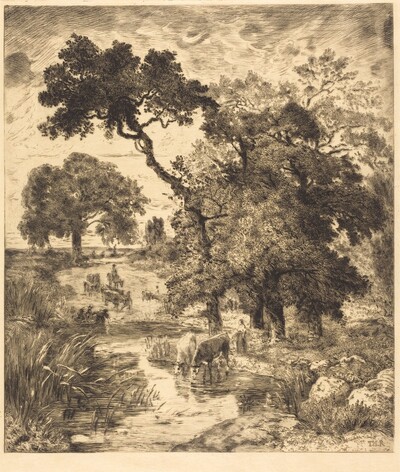
Théodore Rousseau's Landscape with Boatman, painted around 1860, exemplifies the Barbizon School's revolutionary approach to landscape painting. Rousseau, who had been systematically rejected by the Paris Salon throughout the 1830s and 1840s—earning the nickname 'le grand refusé'—painted this work during his mature period when he had finally gained critical recognition. The composition presents a river landscape with a boatman navigating calm waters, rendered with the dense, textured brushwork that became Rousseau's signature. Unlike the idealized Italianate landscapes favored by the Academy, Rousseau paints a real French river scene—specific, observed, and faithful to the quality of natural light. The 1860s context is crucial: France was industrializing rapidly, and the forest of Fontainebleau where the Barbizon School worked was itself under threat from commercial logging. Rousseau became an early environmental activist, successfully campaigning to preserve parts of the forest. This painting, with its serene river scene and solitary boatman, represents the rural France that industrialization was transforming—a world that Rousseau championed not through nostalgia but through careful, loving attention to its actual appearance.
Cultural Impact
Rousseau's landscape painting directly influenced the Impressionists—Monet, Renoir, and Sisley all worked near Barbizon early in their careers and absorbed Rousseau's commitment to plein-air observation. His textured surfaces and naturalistic color also influenced the Hague School in the Netherlands and the Heidelberg School in Australia. Landscape with Boatman contributed to the broader cultural movement that valued rural France as a national heritage, influencing early conservation efforts and the eventual creation of the Fontainebleau artistic reserves.
Why It Matters
This painting matters because it represents a pivotal shift in the history of landscape painting: from imaginative compositions based on classical principles to direct observation of actual places. Rousseau's insistence that a specific French river, at a specific moment, under specific light, deserved serious artistic attention was itself a revolutionary act. It established the principle that artistic truth begins with looking, not with conventions—a principle that remains foundational for all observational art.