Provenance
Purchased from the artist by George S. Palmer, New London, Connecticut; consigned by (Milch Galleries, New York) to (sale, American Art Galleries, New York, 23 January 1926, no. 74); Chester Dale [1883-1962], New York;[1] bequest 1963 to NGA.
[1] The painting was listed in the sale catalogue, _European And American Paintings from the Collection of Mrs. I. N. Seligman....and the Estate of William H. Sharp....and Other Private Collectors_ (American Art Galleries, New York, 1926), no. 74.
Accession Number
1963.10.202
Medium
oil on canvas
Dimensions
overall: 71.2 x 91.7 cm (28 1/16 x 36 1/8 in.) | framed: 106.7 x 127 x 9.5 cm (42 x 50 x 3 3/4 in.)
Classification
Painting
Credit Line
Chester Dale Collection
Tags
Painting Early Modern (1901–1950) Oil Painting Canvas American
Background & Context
Background Story
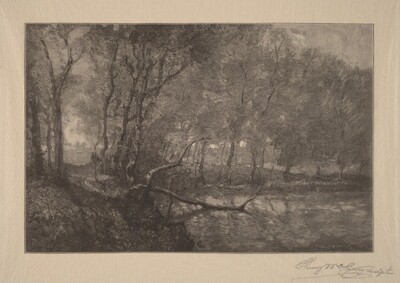
Henry Ward Ranger (1858-1916) was the founder of the Old Lyme Art Colony in Connecticut and one of the key figures in the American Tonalist movement. Spring Woods, from around 1910, is a mature work that shows Ranger's characteristic approach to the New England forest: a subdued palette of greens, browns, and grays, arranged in broad masses that emphasize the tonal relationships between light and shadow rather than the specific details of individual trees. The spring setting allows for a slightly warmer palette than Ranger's usual autumnal schemes, but the overall effect remains tonally unified — the forest as a single atmospheric experience rather than a collection of individual observations.
Cultural Impact
Ranger's Spring Woods participates in the Tonalist tradition that dominated American landscape painting in the late 19th and early 20th centuries, before it was supplanted by the brighter palette of Impressionism. Tonalism valued mood, atmosphere, and the viewer's emotional response over the specific topographic detail that the earlier Hudson River School had favored. Ranger's Old Lyme colony was one of the centers of this tradition, and Spring Woods is a textbook example of its approach.
Why It Matters
Spring Woods is Ranger's Tonalism at its most characteristic: a forest rendered as a single atmospheric experience, with greens and browns organized by tonal value rather than local color. The spring setting provides a slightly warmer key, but the mood is still contemplative — the forest as a place of thought rather than a collection of botanical specimens.