Provenance
Pierre Decourcelle [1856-1926], Paris; (his sale, Hôtel Drouot, Paris, 16 June 1926, no. 80); purchased by (Galerie Tanner, Zurich). (Galerie Le Portique, Paris); sold 1929 to Chester Dale [1883-1962], New York; bequest 1963 to NGA.
Accession Number
1963.10.222
Medium
oil on canvas
Dimensions
overall: 73 x 54 cm (28 3/4 x 21 1/4 in.) | framed: 91.4 x 72.4 x 5.7 cm (36 x 28 1/2 x 2 1/4 in.)
Classification
Painting
Credit Line
Chester Dale Collection
Tags
Painting Early Modern (1901–1950) Oil Painting Canvas French
Background & Context
Background Story
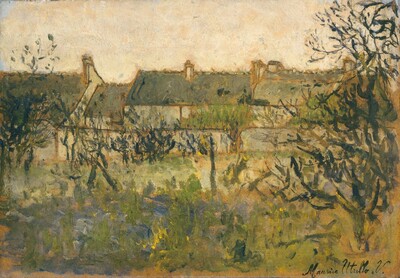
Maurice Utrillo's The Church of Saint-Séverin (c. 1913) depicts one of Paris's oldest churches, located in the Latin Quarter on the Left Bank. Saint-Séverin, a Gothic church dating to the 11th century, provided Utrillo with a subject at the intersection of religious architecture and Parisian street life. Utrillo, the son of painter Suzanne Valadon, painted Paris streets with an obsessive regularity that reflected both his deep attachment to the city and his mental health struggles. By 1913, Utrillo was developing the distinctive white-on-white technique that would characterize his most celebrated period—the 'white period' in which he mixed sand and plaster into white paint to create the sun-bleached walls of Montmartre and the Latin Quarter. Saint-Séverin's Gothic architecture—its Flamboyant portal, its asymmetric towers, its street-level presence among the shops and cafés of the rue Saint-Jacques—provided exactly the kind of architectural subject Utrillo rendered most effectively: solid, specific, and thoroughly Parisian. The painting likely emphasizes the church's stonework—the whites and grays that earned Utrillo the nickname 'the painter of white'—while the street's human activity provides scale and warmth against the church's architectural permanence.
Cultural Impact
Utrillo's church paintings influenced how Parisian religious architecture was represented in art, establishing a visual vocabulary for the Paris church-as-street-feature that influenced later painters and photographers. His white period influenced the development of French post-Impressionist cityscape painting and contributed to the cultural identity of the Latin Quarter and Montmartre as artistic neighborhoods. Utrillo's approach influenced naïve and outsider art traditions by demonstrating that mental illness could coexist with— and perhaps intensify—artistic achievement.
Why It Matters
This painting matters because it represents Parisian modernism's turn toward the city itself as subject—away from the Impressionist emphasis on light and toward the solid, built environment that gives Paris its character. Utrillo's Saint-Séverin is not an impression of light on stone; it is stone itself, rendered with a materiality that makes the viewer feel the wall's surface. This commitment to architectural substance anticipates later realist and Magic Realist approaches to urban landscape.