Provenance
Max Pellequer, Paris; (sold, Hôtel Drouot, Paris, 23 June 1933, no. 90); purchased by Chester Dale [1883-1962], New York; bequest 1963 to NGA.
Accession Number
1963.10.223
Medium
oil on canvas
Dimensions
overall: 59.7 x 81 cm (23 1/2 x 31 7/8 in.) | framed: 82.6 x 103.5 x 7.9 cm (32 1/2 x 40 3/4 x 3 1/8 in.)
Classification
Painting
Credit Line
Chester Dale Collection
Tags
Painting Early Modern (1901–1950) Oil Painting Canvas French
Background & Context
Background Story
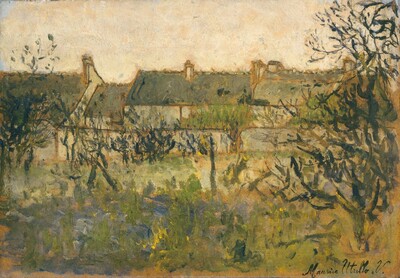
Marizy-Sainte-Geneviève (c. 1910) depicts a small town or street in the provinces—specifically in the Morvan region of Burgundy, where Utrillo's grandmother lived and where he spent time recuperating from his ongoing struggles with alcoholism and mental illness. The painting's departure from Utrillo's usual Paris subjects is significant: it represents an attempt to find stability through connection with rural roots and familial support. Marizy-Sainte-Geneviève, named for the patron saint of Paris, connects provincial France to the capital through shared religious heritage. The painting likely features the white-washed walls, narrow streets, and rural architecture that Utrillo rendered with his distinctive technique—white paint thickened with sand and plaster that creates the tactile quality of sun-bleached provincial masonry. The year 1910 falls within Utrillo's most productive and critically acclaimed period, when his white period was producing some of the most admired cityscapes in French painting. The provincial setting allows Utrillo to demonstrate that his technique was not dependent on Parisian subjects—the same tactile handling works as effectively on rural walls as on urban ones, suggesting that his artistic vision was rooted in perception rather than place.
Cultural Impact
Utrillo's provincial paintings influenced how rural French architecture was represented in art, contributing to the regionalist tradition in French landscape and cityscape painting. The paintings demonstrated that Utrillo's distinctive technique served any architectural subject, influencing later painters who worked in provincial French settings. The connection to the Morvan region also influenced how the area was perceived as a landscape of artistic significance.
Why It Matters
This painting matters because it demonstrates that artistic identity is formed by how one sees rather than what one sees. Utrillo's Paris is unmistakably Utrillo's; his Marizy-Sainte-Geneviève is equally unmistakable—same vision, different place. For contemporary artists developing personal styles, the painting offers reassurance that a genuine way of seeing will serve any subject, not just the subjects that produced it.