Provenance
The sitter's mother, Mrs. Richard H. Townsend [d. 1931, née Mary Scott], Washington, D.C.; by inheritance to the sitter, Mathilde Townsend Gerry Welles [1888-1949], Washington, D.C.; bequest 1949 to NGA, with life interest to her husband, Sumner Welles [1892-1961].
Accession Number
1952.3.1
Medium
oil on canvas
Dimensions
overall: 152.7 x 101.6 cm (60 1/8 x 40 in.) | framed: 182.9 x 132.1 x 15.2 cm (72 x 52 x 6 in.)
Classification
Painting
Credit Line
Gift of the sitter, Mrs. Sumner Welles
Tags
Painting Early Modern (1901–1950) Oil Painting Canvas American
Background & Context
Background Story
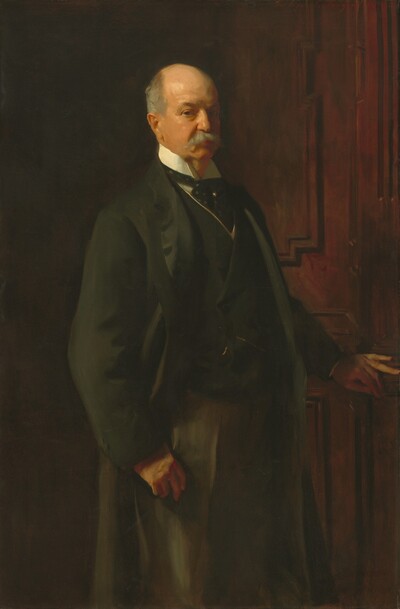
Miss Mathilde Townsend (c. 1906-1907) is one of Sargent's later portraits of the Washington social elite—figures whose position in the capital's social hierarchy made them essential subjects for a portraitist who chronicled the Anglo-American upper class. The 1906-07 date places this during Sargent's late portrait period, when he was beginning to reduce his portrait practice and to focus on the landscape and genre subjects that he preferred. Miss Townsend's portrait demonstrates the method that Sargent had refined over three decades of portrait practice: the figure is rendered with the authority that came from experience, the characterization reveals the personality with the precision that his best portraits achieved, and the handling—the brushwork, the tonal values, and the compositional decisions—shows the freedom that late Sargent permitted himself. The portrait also documents the Washington social world at a specific historical moment—the early 20th century, when the capital's social hierarchy was becoming more formalized and when the portrait practices that had defined European aristocratic society were being adopted by the American elite. Mathilde Townsend, whose family was one of Washington's most prominent, embodied the social authority that Sargent's portraits consistently revealed.
Cultural Impact
Sargent's late portraits influenced how the Washington social elite was represented, documenting the capital's social hierarchy at a specific historical moment. The portraits influenced how American portraiture was understood in relation to its European precedents, connecting American social authority to European portrait traditions. Miss Mathilde Townsend influenced how feminine social authority was visualized in early 20th-century Washington.
Why It Matters
This painting matters because it captures the Washington social elite at a specific historical moment—the early 20th century, when the capital's social hierarchy was becoming more formalized—with the authority and freedom that Sargent's late portraits achieved. Miss Townsend's social presence is preserved with the precision that made Sargent the definitive portraitist of the Anglo-American elite.