
Provenance
Possibly commissioned for a convent or church in Valladolid, Spain.[1] Before 1919, José María de Palacio, Conde de las Almenas, Madrid;[2] sold 28 March 1919 to (Frank Partridge and Sons, Ltd., London).[3] Dr. Preston Pope Satterwhite [1867-1948], New York, by 1933;[4] possibly purchased by (French & Co., New York).[5] purchased 1941 by the Samuel H. Kress Foundation, New York;[6] gift 1952 to NGA.
[1] The probable patronage of the Catholic Kings has led Van der Put and subsequent commentators to posit that the altarpiece was commissioned for a church or convent in Valladolid. Albert van der Put, typescript, c. 1922, in NGA curatorial files. The painting has qualities characteristic of Spanish paintings in northern Castile during the reign of the Catholic Kings. Among cities in the region, Valladolid was the one most favored by the monarchs, who occasionally held court there. The theory that the panels were intended for an institution in Valladolid is plausible, but cannot be regarded as certain. Even if the paintings were created in northern Castile, they could have been commissioned for an institution in another part of Spain.
[2] This painting is shown hanging on a wall of the Madrid residence of the Conde de las Almenas in a photograph in Arthur Byne and Mildred Shapley, _Spanish Interiors and Furniture_, 2 vols. (New York, 1922), 2: pl. 109.
[3] Frank Partridge, memorandum, 1924, in the files of the Frick Art Reference Library, New York.
[4] Chandler R. Post, _A History of Spanish Painting_ (Cambridge, Mass., 1933), v. IV, pt. II, 418.
[5] From Colin Eisler, _Paintings from the Samuel H. Kress Collection: European Schools Excluding Italian_ (Oxford, 1977), 178 and provenance card, NGA curatorial files; however in her 26 August 1988 letter, Martha Hepworth of the Getty Provenance Index indicates that these panels do not appear in the French & Co. stock books, which are now at the Getty. Robert Samuels, Jr., a representative of French & Co., searched the French & Co. records still kept at the New York office, but also was unable to find any references to the two panels.
[6] Provenance card, NGA curatorial files. See also The Kress Collection Digital Archive, https://kress.nga.gov/Detail/objects/2238.
Accession Number
1952.5.42
Medium
oil on panel
Dimensions
overall (original painted surface): 137.1 x 92.7 cm (54 x 36 1/2 in.) | overall (with addition at bottom): 153.1 x 92.7 cm (60 1/4 x 36 1/2 in.) | overall (with added border strips): 155.7 x 95.8 cm (61 5/16 x 37 11/16 in.) | framed: 184.8 x 130.5 x 12.7 cm (72 3/4 x 51 3/8 x 5 in.)
Classification
Painting
Credit Line
Samuel H. Kress Collection
Tags
Painting Renaissance (1400–1599) Oil Painting Panel Painting Spanish
Background & Context
Background Story
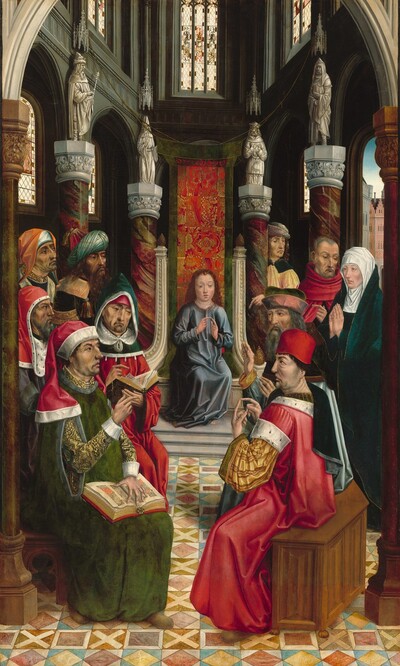
The Master of the Catholic Kings (active c. 1490-1500) was a Spanish painter named after a retablo of the Catholic Kings in the Prado, known for the combination of Hispano-Flemish detail and Spanish religious intensity that distinguishes the best Spanish painting of the late 15th century. The Marriage at Cana from c. 1495-97 depicts the biblical episode in which Christ transforms water into wine at a wedding feast, rendered with the Hispano-Flemish detail and Spanish religious intensity that distinguish the Master's best work. The c. 1495-97 date places this at the turn of the 16th century, when Spanish painting was producing some of its most accomplished Hispano-Flemish works.
Cultural Impact
The Marriage at Cana is important in the history of Spanish painting because it demonstrates the Hispano-Flemish manner that distinguishes the best Spanish painting of the late 15th century. The Master of the Catholic Kings combines the Netherlandish detail of his Flemish training with the Spanish religious intensity that defines the Spanish tradition, creating a type of painting that is simultaneously detailed and intense—a combination that would define Spanish painting throughout the Golden Age.
Why It Matters
The Marriage at Cana is the Master of the Catholic Kings combining Flemish detail with Spanish intensity: the biblical wedding feast rendered in the Hispano-Flemish manner that defines the best Spanish painting of the late 15th century. The c. 1495-97 painting shows Spanish painting at the turn of the 16th century, detailed and intense.
![Saint Bernard and Saint Catherine of Alexandria with the Virgin of the Annunciation [right panel]](https://api.nga.gov/iiif/e6890364-4d99-4684-a62b-5060ee3c3446/full/400,/0/default.jpg)