Provenance
John W. Simpson [1850-1920], New York.[1] Possibly sold 1908 by (M. Knoedler & Co., New York) to R. Horace Gallatin [1871-1948], New York, in whose collection the painting was by 1941;[2] bequest 1949 to NGA.
[1] According to Gallatin. This may also be the same Cazin, "The Windmill," sold to Gallatin December 1908, having been returned to Knoedler's from an A.W. Smith.
[2] The painting was part of the Gallatin collection in 1941 when the collection was initially offered to the National Gallery of Art, and accepted on an "if and when" basis; see NGA curatorial files.
Accession Number
1949.1.1
Medium
oil on wood
Dimensions
overall: 40.5 x 32 cm (15 15/16 x 12 5/8 in.) | framed: 66 x 57.8 x 8.3 cm (26 x 22 3/4 x 3 1/4 in.)
Classification
Painting
Credit Line
Gift of R. Horace Gallatin
Tags
Painting Impressionist & Modern (1851–1900) Oil Painting French
Background & Context
Background Story
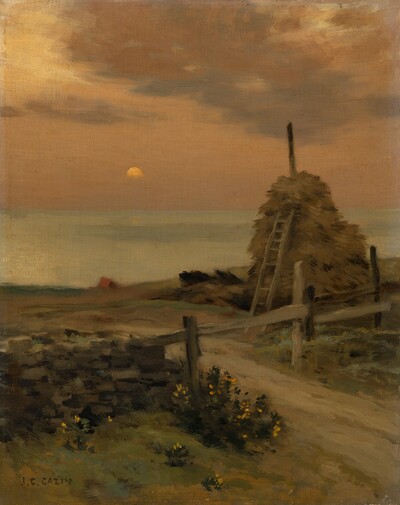
Cazin's windmill paintings belong to a tradition that stretches back through Millet and the Barbizon School to the Dutch Golden Age. His windmills, however, are not the dramatic windmills of Rembrandt or Ruisdael — they are quiet, functional structures set within the flat landscapes of northern France. This small panel on wood shows Cazin working in the intimate format that suited his meditative style: the windmill is a vertical accent in a horizontal composition, a point of stillness in the landscape rather than a symbol of Romantic force.
Cultural Impact
Cazin spent much of his career painting the landscapes around Boulogne-sur-Mer and the Pas-de-Calais, where windmills were still working structures in the 19th century. His treatment of them as ordinary features of the rural scene — neither picturesque ruins nor symbols of Dutch mastery over nature — connects him to the Realist tradition that Millet established and the Barbizon painters perpetuated.
Why It Matters
The Windmill is Cazin at his most characteristic: a quiet, unassuming structure in a quiet, unassuming landscape, painted with the restraint and tonal subtlety that made him one of the most respected landscape painters of the late 19th century.