Provenance
(M. Knoedler & Co., Paris), by 1932 until at least 1947.[1] Mrs. Charles Stewart Carstairs [née Elizabeth Stebbins, d. 1949], Lockport and Paris;[2] bequest 1952 to NGA.
[1] With Knoedler per Paul Jamot and Georges Wildenstein, _Manet_, 2 vols, Paris, 1932: I:240, no. 307. However, Margaret Iacono's 2016 article cites M. Knoedler & Co. records that indicate Charles Stewart Carstairs purchased the painting in 1914 (Margaret Iacono, "Charles Stewart Carstairs and Camille Pissaro's 'The Côte des Boeufs a L'Hermitage': model of magnanimity or marketing strategy?." _The Burlington Magazine_ 158 [August 2016]: 635, fig. 36, 635 n. 40).
[2] Mrs. Carstairs was the widow of Charles Stewart Carstairs [1865-1928], who was part of the firm of M. Knoedler & Co., and the stepmother of Carroll Carstairs [d. 1948], who likewise worked with Knoedler before opening his own firm in 1934.
Accession Number
1952.9.1
Medium
oil on wood
Dimensions
overall: 15 x 11.4 cm (5 7/8 x 4 1/2 in.) | framed: 31.3 x 28.3 x 4.4 cm (12 5/16 x 11 1/8 x 1 3/4 in.)
Classification
Painting
Credit Line
Gift of Mrs. Charles S. Carstairs
Tags
Painting Impressionist & Modern (1851–1900) Oil Painting French
Background & Context
Background Story
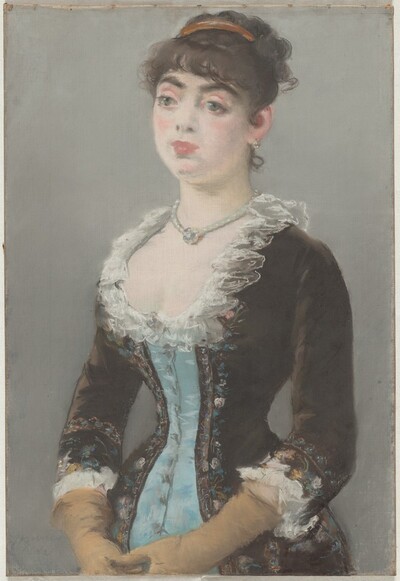
Portrait of a Lady from around 1879 is a late work by Manet, painted during the period when he was increasingly confined by illness but continued to produce portraits of remarkable immediacy and psychological insight. The small format (oil on wood) suggests an intimate, quickly executed work—the kind of portrait that Manet could complete in a single sitting, capturing the sitter's expression and social presence with an economy of means that reflects his late style. The lady's identity is unknown, but her fashion and bearing place her firmly in the Parisian upper bourgeoisie that was Manet's preferred social world.
Cultural Impact
Manet's late portraits are among his most direct and intimate works. The small format and rapid execution of Portrait of a Lady suggest an artist working against the constraints of illness to capture the essential character of his sitter. The painting's directness—the straightforward pose, the unembellished background, the focused attention on the face—demonstrates that Manet's late style was moving toward an even greater economy of means that would influence the next generation of portrait painters.
Why It Matters
Portrait of a Lady is late Manet at his most direct: an intimate, quickly executed portrait that captures the sitter's social presence with an economy of means reflecting both his artistic maturity and the constraints of illness. The small format concentrates attention on the face, the personality, and the fashion that placed this woman in Manet's Parisian world.