Provenance
Bequeathed by the sitter's mother, Joanna Barry [d. 1811], Washington, D.C., to her nephew, James David Barry [1774-1849], Washington, D.C.;[1] by descent to George Worthen Whistler [b. 1851], Baltimore;[2] sold by G. D. Whistler at (Christie, Manson & Woods, London, 4 February 1927, no. 62); bought by (Arthur Tooth, London).[3] Sold by (Daniel H. Farr Co., New York and Philadelphia) to Edward Small Moore [1881-1948], New York, 1927;[4] his wife, Jean McGinley Moore Draper [Mrs. Charles Dana Draper, 1884/1885-1954], New York;[5] bequest 1954 to NGA.
[1] Mrs. Barry died in Washington on 18 October 1811; _Federal Gazette and Baltimore Daily Advertiser_, 21 October 1811 (obituary). Her will (Office of Public Records, Washington) bequeathes "also to the same James D. Barry his uncles, my own and two dear childrens likenesses done by Steward. . . ." For James David Barry's dates see his obituary in the (Washington) _Daily National Intelligencer_, 16 August 1849.
[2] George C. Mason, _The Life and Works of Gilbert Stuart_, New York, 1879, 134; Lawrence Park, _Gilbert Stuart: An Illustrated Descriptive List of his Works, with an Account of his Life by John Hill Morgan and an Appreciation by Royal Cortissoz_, 4 vols, New York, 1926, 133. George Worthen Whistler was the great-grandson of Robert Barry, brother of James David Barry. Robert Barry's daughter Joanna married Julius Timolean Ducatel in 1824. Their daughter Mary married George William Whistler, older step-brother of painter James McNeill Whistler, in 1848. Their son George Worthen Whistler was born in 1851 (letter from Dr. Nigel Thorp, Glasgow University Library, Scotland, 19 March 1991; NGA curatorial file). According to the 1880 Baltimore census, George Worthen Whistler lived at 56 Bolton Street with his wife Esther A. and daughter Esther M. The census notes that he was "not w any business." Mrs. G.W. Whistler is listed as the owner in Museum of Fine Arts, "Portraits Painted by Stuart...taken from Mason's _Life and Works of Gilbert Stuart_," _Exhibition of Portraits Painted by Gilbert Stuart_, Boston, 1880, 30, no. 46.
[3] Memo from Jeremy Rex-Parkes, archivist, Christie, Manson & Woods, London, 15 March 1991 (NGA curatorial file). Daniel Farr wrote William Campbell on 24 July 1961 (NGA curatorial file) that the paintings were sold at Christie's by an owner from Lucerne, Switzerland. The buyer's name is found in an annotated copy of Christie's catalogue (copy, NGA curatorial file) and in _Art Prices Current_, N.s., vol. 6 (1926-1927), 128.
[4] Sales receipt dated 15 December 1927 (NGA curatorial file); for Moore's dates see _The New York Times_, 28 September 1948 (obituary).
[5] The paintings (see also NGA 1954.9.4) were first documented in the collection of Jean McGinley Moore Draper in March 1937 when they were stored at M. Knoedler & Co. in New York; letter from Melissa De Medeiros, librarian, M. Knoedler & Co., 18 January 1991 (NGA curatorial file). For Mrs. Draper's dates see _The New York Times_, 27 September 1954 (obituary).
Accession Number
1954.9.3
Medium
oil on canvas
Dimensions
overall: 74.3 x 61 cm (29 1/4 x 24 in.) | framed: 94.8 x 81.4 x 8.2 cm (37 5/16 x 32 1/16 x 3 1/4 in.)
Classification
Painting
Credit Line
Gift of Jean McGinley Draper
Tags
Painting Neoclassical & Romantic (1751–1850) Oil Painting Canvas American
Background & Context
Background Story
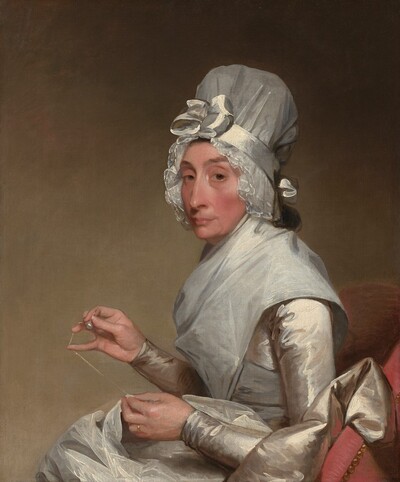
Gilbert Stuart's portrait of Ann Barry (1803/1805) depicts a member of the Barry family—likely connected to the prominent Barrys of Boston or Philadelphia. The portrait's dating to 1803-05 places it during Stuart's most productive period in Washington and Boston, when he was painting the political and social elite of the early Republic with the fluency that made him the most sought-after portraitist in America. Ann Barry's portrait exemplifies Stuart's approach to women's portraiture: less formal than European models, more attentive to personality than to social position, and demonstrating that American femininity could be represented with the same technical mastery that European painters reserved for aristocratic subjects. The portrait's handling demonstrates Stuart's characteristic technical strategy: the face is rendered with precise, layered brushwork that captures the sitter's individual features, while the costume and background are suggested with broader, more economical strokes. This hierarchy of finish—detailed where the eye naturally focuses, abbreviated where it does not—creates an effect of completeness without labor, an apparent ease that conceals considerable technical sophistication.
Cultural Impact
Stuart's women's portraits influenced how American femininity was represented in the early Republic, establishing conventions of naturalness and intellectual presence that distinguished American portraiture from European formality. The portraits influenced later American portraitists who similarly sought to combine technical refinement with personal directness. The Barry portrait specifically contributed to the visual record of early American society that would become increasingly valuable as the Republic aged.
Why It Matters
This portrait matters because it demonstrates how American portraiture developed its own conventions rather than simply imitating European models. Stuart's Ann Barry is neither a European grande dame nor an American democratic everywoman—she is a specific individual rendered with the attentiveness that great portraiture demands. For contemporary portraitists, the painting offers a model for balancing specificity and universality within a single image.