Provenance
Bequeathed by the sitter's mother, Joanna Barry [d. 1811], Washington, D.C., to her nephew, James David Barry [1774-1849], Washington, D.C.;[1] by descent to George Worthen Whistler [b. 1851], Baltimore;[2] sold by G. D. Whistler at (Christie, Manson & Woods, London, 4 February 1927, no. 63); bought by "Barry."[3] Sold by (Daniel H. Farr Co., New York and Philadelphia) to Edward Small Moore [1881-1948], New York, 1927;[4] his wife, Jean McGinley Moore Draper [Mrs. Charles Dana Draper, 1884/1885-1954], New York;[5] bequest 1954 to NGA.
[1] Mrs. Barry died in Washington on 18 October 1811; _Federal Gazette and Baltimore Daily Advertiser_, 21 October 1811 (obituary). Her will (Office of Public Records, Washington) bequeathes "also to the same James D. Barry his uncles, my own and two dear childrens likenesses done by Steward. . . ." For James David Barry's dates see his obituary in the (Washington) _Daily National Intelligencer_, 16 August 1849.
[2] George C. Mason, _The Life and Works of Gilbert Stuart_, New York, 1879, 134; Lawrence Park, _Gilbert Stuart: An Illustrated Descriptive List of his Works, with an Account of his Life by John Hill Morgan and an Appreciation by Royal Cortissoz_, 4 vols, New York, 1926, 133. George Worthen Whistler was the great-grandson of Robert Barry, brother of James David Barry. Robert Barry's daughter Joanna married Julius Timolean Ducatel in 1824. Their daughter Mary married George William Whistler, older step-brother of painter James McNeill Whistler, in 1848. Their son George Worthen Whistler was born in 1851 (letter from Dr. Nigel Thorp, Glasgow University Library, Scotland, 19 March 1991; NGA curatorial file). According to the 1880 Baltimore census, George Worthen Whistler lived at 56 Bolton Street with his wife Esther A. and daughter Esther M. The census notes that he was "not w any business." Mrs. G.W. Whistler is listed as the owner in Museum of Fine Arts, "Portraits Painted by Stuart...taken from Mason's _Life and Works of Gilbert Stuart_," _Exhibition of Portraits Painted by Gilbert Stuart_, Boston, 1880, 30, no. 46.
[3] "Barry" was either a pseudonym or the name of an agent for A. L. Nicholls; see memo from Jeremy Rex-Parkes, archivist, Christie, Manson & Woods, London, 15 March 1991 (NGA curatorial file), an annotated copy of Christie's catalogue (photocopy, NGA curatorial file), and _Art Prices Current_, N.s., vol. 6 (1926-1927), 128.
[4] Sales receipt dated 15 December 1927 (NGA curatorial file); for Moore's dates see _The New York Times_, 28 September 1948 (obituary).
[5] The paintings (see also NGA 1954.9.3) were first documented in the collection of Jean McGinley Moore Draper in March 1937 when they were stored at M. Knoedler & Co. in New York; letter from Melissa De Medeiros, librarian, M. Knoedler & Co., 18 January 1991 (NGA curatorial file). For Mrs. Draper's dates see _The New York Times_, 27 September 1954 (obituary).
Accession Number
1954.9.4
Medium
oil on canvas
Dimensions
overall: 74.3 x 61.6 cm (29 1/4 x 24 1/4 in.) | framed: 95.2 x 82.5 x 8.8 cm (37 1/2 x 32 1/2 x 3 7/16 in.)
Classification
Painting
Credit Line
Gift of Jean McGinley Draper
Tags
Painting Neoclassical & Romantic (1751–1850) Oil Painting Canvas American
Background & Context
Background Story
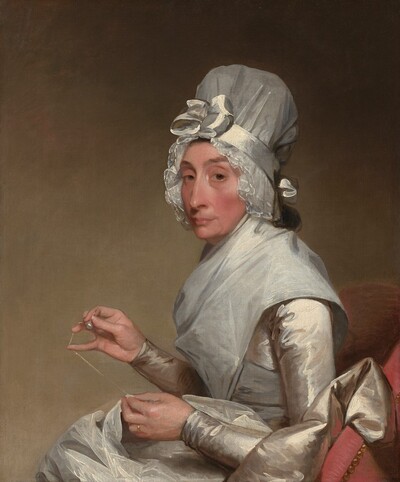
Mary Barry (1803/1805), likely a sister or relative of Ann Barry, provides a companion to the earlier portrait and demonstrates Stuart's ability to differentiate individual character within the same social type. Painted during the same period and possibly as part of a family commission, the portrait of Mary Barry reveals how Stuart found personality within the conventions of Federal-era portraiture. The two Barry portraits together demonstrate how family portraiture served both individual representation and social documentation—each sitter is an individual person, yet together they represent a family's collective identity within the early Republic's social structure. Stuart's handling of Mary Barry likely differs from his treatment of Ann in ways that reveal character rather than technique—the same technical approach serves different personalities, producing portraits that are recognizably Stuart's yet distinctly different sitters. The 1803-05 dating places these portraits during the period when the Federal city was emerging from construction sites and muddy roads into something approaching a capital. The Barry family, commissioning portraits in this period, was participating in the creation of Washington's social infrastructure.
Cultural Impact
Stuart's family portrait pairs influenced how American family identity was visualized, establishing conventions for representing familial relationships through portraiture that persisted through the 19th century. The paired portraits influenced how the early Republic's social structure was documented and understood, providing visual evidence of the families who constituted the new nation's elite. The portraits also influenced American domestic interior design, determining what kind of images occupied the walls of Federal-era homes.
Why It Matters
This portrait matters because it demonstrates that great portraiture is about seeing rather than technique. The same technical approach that produced Ann Barry's portrait produces Mary Barry's portrait, yet the two women are clearly different people—a result that can only be achieved by an artist who is truly looking rather than merely painting. For contemporary audiences, the paired Barry portraits demonstrate that artistic skill and perceptual skill are inseparable.