
Provenance
George M. Salting [1835-1909], London;[1] sold 1901 to (Thos. Agnew and Sons Ltd., London); sold the same year to (Asher Wertheimer, London).[2] Nikolaus von Uthemann [d. 1925; the name also spelled Utheman and Huthemann], St. Petersburg and Lucerne, by 1914;[3] sold May 1925 to (Lucerne Fine Art Co./Boehler & Steinmeyer, Lucerne);[4] sold to Ralph Harman [1873-1931] and Mary Batterman [d. 1951] Booth, Grosse Point, Michigan, by December 1926;[5] by inheritance to their daughter and son-in-law, William D. and Virginia Booth Vogel, Milwaukee; gift 1955 to NGA.
[1] According to the article "Mr. Asher Wertheimer's Exhibition," _Connoisseur_ V (April 1903): supplement.
[2] The Getty Provenance Index kindly provided a copy of the page from the Agnew's stock book (in NGA curatorial files) that lists the painting as number 9797, titled _Fête Champetre_. The stock book confirms the purchase from Salting, with half profit to Charles Fairfax Murray, and the sale to Wertheimer.
[3] Frederick William Steinmeyer, letter to Ralph Harman Booth, 10 February 1926, copy in NGA curatorial files. The letter reads: "Afterwards it was in the collection of His Excellency von Utheman, who was the private secretary to the Czar of Russia. It hung in his palace at St. Petersburg up to the time of the Revolution, when some of his faithful servants took this picture with other valuables to the protection of the British Consul, who after the War [World War I] returned them to Utheman." The 1914 date comes from information about the painting provided by Steinmeyer along with this letter to Booth.
[4] See note 3. The letter continues: "We bought the picture directly from His Excellency von Utheman in Geneva. His Excellency died this summer in Lucerne." As the letter was written in February, the second sentence was probably meant to read "this past summer," putting Von Uthemann's death in 1925. A letter to Ralph Harman Booth dated Lucerne, 21 August 1925, on letterhead that reads "The Lucerne Fine Art Co. Ltd., Management Boehler & Steinmeyer" indicates that the picture was by then in Munich and quotes the asking price. The Getty Provenance Index also provided a copy of the page from the Julius Bohler records that lists the painting as stock number 134-25, bought from Uthemann on 28 May 1925.
[5] The Booths lent the painting to an exhibition that opened 2 December 1926 at the Detroit Institute of Arts.
Accession Number
1955.3.1
Medium
oil on canvas
Dimensions
overall: 71.8 x 100 cm (28 1/4 x 39 3/8 in.) | framed: 90.2 x 117.5 x 8.9 cm (35 1/2 x 46 1/4 x 3 1/2 in.)
Classification
Painting
Credit Line
Gift of Mr. and Mrs. William D. Vogel in memory of her father and mother, Mr. and Mrs. Ralph Harmon Booth
Tags
Painting Baroque (1600–1750) Oil Painting Canvas French
Background & Context
Background Story
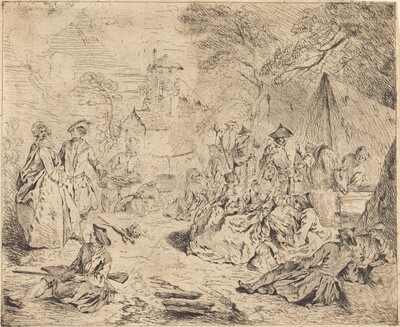
Jean-Baptiste Joseph Pater (1695-1736) was a French painter known as the most important follower of Watteau, whose fetes galantes—elegant outdoor parties—make him one of the most important painters of the Rococo period. On the Terrace from c. 1730/1735 depicts elegant figures on a terrace in the fetes galantes manner that Pater developed from Watteau, combining the elegant outdoor setting with the graceful figures that are characteristic of the Rococo. The c. 1730/1735 date places this in Pater's most productive period, when he was producing the fetes galantes that made him the most important follower of the tradition that Watteau had invented.
Cultural Impact
On the Terrace is important in the history of French Rococo painting because it demonstrates the fetes galantes manner that Pater developed from Watteau as the most important follower of the tradition. Pater's fetes galantes—combining elegant outdoor settings with graceful figures in the manner of Watteau—represent the most important continuation of the tradition that Watteau invented, and the c. 1730/1735 painting shows this tradition at its most graceful and accomplished.
Why It Matters
On the Terrace is Pater's fetes galantes: elegant figures on a terrace in the graceful manner of Watteau's most important follower. The c. 1730/1735 painting shows the Rococo tradition of elegant outdoor parties at its most graceful—the most important continuation of the tradition that Watteau invented.


![A Comic Actor Dressed as a Gentleman [recto]](https://api.nga.gov/iiif/345fc69a-7cde-4cb4-8ac0-25666abedeba/full/400,/0/default.jpg)