Provenance
Descended in the Herbert family, New Jersey. (Edith Gregor Halpert, Downtown Gallery, New York, 1945), by whom sold in 1946 to Edgar William and Bernice Chrysler Garbisch; gift to NGA, 1955.
Accession Number
1955.11.2
Medium
oil on canvas
Dimensions
overall: 63.3 x 80.3 cm (24 15/16 x 31 5/8 in.) | framed: 76.2 x 93.3 x 5.3 cm (30 x 36 3/4 x 2 1/16 in.)
Classification
Painting
Credit Line
Gift of Edgar William and Bernice Chrysler Garbisch
Tags
Painting Impressionist & Modern (1851–1900) Oil Painting Canvas American
Background & Context
Background Story
The Herbert Children is a portrait by Lambert Sachs dated 1857, depicting the children of the Herbert family during the height of the Victorian era. Lambert Sachs, whose practice centered on mid-nineteenth-century portraiture, created this work at a time when the genre of children's portraiture was undergoing significant transformation in both Britain and America. The Victorian period elevated childhood to a status of unprecedented cultural importance, influenced by Romantic ideas about the innocence and spiritual purity of children and by the growing middle-class emphasis on family, domesticity, and parental affection. Portraits of children became increasingly common and increasingly elaborate during this period, reflecting both the growing affluence of the middle classes and the new cultural investment in childhood as a precious and formative stage of life. The Herbert family name carried particular significance in nineteenth-century Britain, most notably through the Anglo-Irish aristocratic dynasty headed by the Earls of Pembroke, whose seat at Wilton House made them among the most prominent patrons of the arts in the kingdom. Whether the subjects of this portrait belonged to that distinguished family or to another branch of the widespread Herbert clan, the commissioning of a group portrait of children was a statement of both familial pride and cultural aspiration. The year 1857 fell during a period of enormous change in British portraiture. The invention of photography was beginning to transform the portrait market, making likenesses available at much lower cost than painted portraits and forcing painters to emphasize the qualitative differences between photographic and painted representations. Painted portraits of children offered what photography of the period could not: the ability to combine likeness with the artistic qualities of color, composition, and brushwork that signaled the sitter's social standing and the family's cultural sophistication.
Cultural Impact
Children's portraiture of the Victorian era both reflected and shaped cultural attitudes toward childhood, creating visual records of family life that reinforced the period's emphasis on domesticity, parental affection, and the sacred nature of childhood. These portraits also served as markers of social status and cultural aspiration, demonstrating a family's ability to commission painted portraits even as photography made likenesses more widely available.
Why It Matters
This portrait matters as a document of Victorian family values and the genre of children's portraiture during a pivotal moment in the history of representation, when painted portraits were redefining their role in response to the challenge of photography.

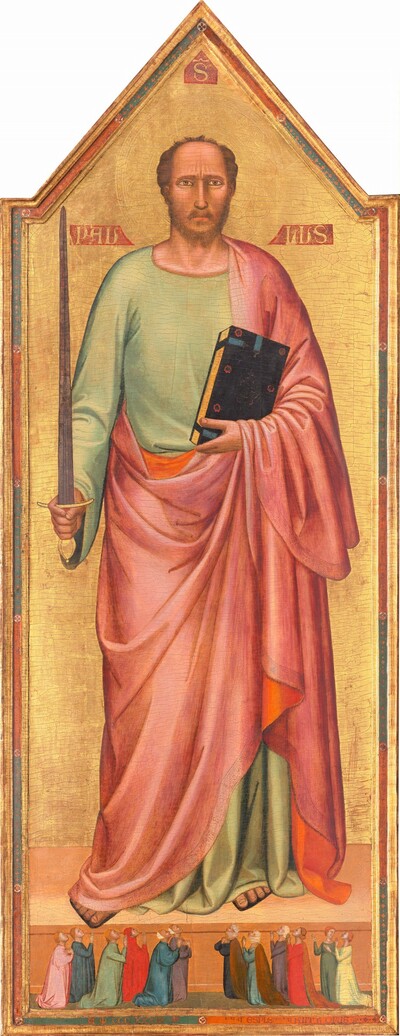
![Saint Bernard and Saint Catherine of Alexandria with the Virgin of the Annunciation [right panel]](https://api.nga.gov/iiif/e6890364-4d99-4684-a62b-5060ee3c3446/full/400,/0/default.jpg)