Provenance
Recorded as from Clermont, New York. Probably John Sanders [1714-1782] of Scotia, New York; by descent to his son, John Sanders II [1757-1834]; by descent to his daughter, Mary Elizabeth Sanders, who married Harold Wilson of Germantown, New York; by descent to their daughters, Anne and Jane Wilson, by whom sold to (Thurston Thacher, Hyde Park, New York), by whom sold in 1952 to Edgar William and Bernice Chrysler Garbisch; gift to NGA, 1956.
Accession Number
1956.13.11
Medium
oil on canvas
Dimensions
overall: 84.2 x 107.6 cm (33 1/8 x 42 3/8 in.) | framed: 95.3 x 118.1 x 4.4 cm (37 1/2 x 46 1/2 x 1 3/4 in.)
Classification
Painting
Credit Line
Gift of Edgar William and Bernice Chrysler Garbisch
Tags
Painting Baroque (1600–1750) Oil Painting Canvas American
Background & Context
Background Story
Lady Undressing for a Bath is attributed to Gerardus Duyckinck and dates to approximately 1730-1740, placing it within the early period of colonial American painting when New York was still developing its distinctive artistic culture. Gerardus Duyckinck (1695-1776) was a member of the prominent Duyckinck family of New York artists and craftsmen who played a significant role in the visual culture of colonial New Amsterdam and New York. The Duyckincks produced paintings, maps, and decorative objects for the city's Dutch and English residents over several generations, serving as a crucial bridge between the artistic traditions of the Netherlands and the developing visual culture of British colonial America. The subject of a lady undressing for a bath is unusual in colonial American painting, where portrait and religious subjects predominated. This work may reflect the continuation of Dutch artistic traditions in New York, where the cultural influence of the original Dutch settlers remained strong despite the English conquest of 1664. In Dutch art, bathing scenes had a long and distinguished history, from the biblical bathers of the Rembrandt school to the more sensual domestic scenes of the seventeenth-century genre painters. By the 1730s, New York's art collectors and painters maintained connections to both Dutch and English artistic traditions, and a painting like this may have been commissioned by a patron with cosmopolitan tastes who was familiar with European painting traditions. The attribution to Duyckinck is significant because it locates the work within the specific context of early New York, where the Duyckinck family workshop produced a range of artistic works for a diverse clientele. The early eighteenth century was a period of growing prosperity and cultural development in New York, as the city expanded its trade networks and its population became increasingly diverse. Artistic production in this period reflected the mix of cultural influences—Dutch, English, German, and others—that characterized the city.
Cultural Impact
This painting demonstrates the persistence of European artistic traditions in colonial America and the complex cultural connections that linked New York to the broader Atlantic world. Works attributed to the Duyckinck family are among the most important surviving examples of early New York painting, documenting the visual culture of a city that was already one of the most cosmopolitan in British North America.
Why It Matters
This painting matters as a rare example of an intimate subject in colonial American art and as evidence of the Duyckinck family's role in transmitting European artistic traditions to the developing visual culture of New York, illustrating how colonial artists navigated between inherited traditions and local demands.

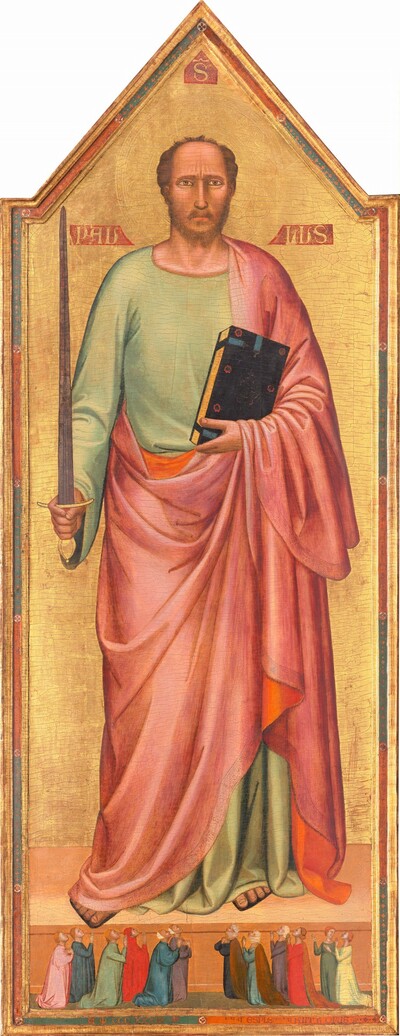
![Saint Bernard and Saint Catherine of Alexandria with the Virgin of the Annunciation [right panel]](https://api.nga.gov/iiif/e6890364-4d99-4684-a62b-5060ee3c3446/full/400,/0/default.jpg)