Provenance
Dr. James Lloyd [1728-1810], Boston, or his son, James Lloyd [1769-1831], Boston;[1] John Borland [1792-1876], Boston, nephew of James Lloyd;[2] his sons, John Nelson Borland [1828-1890] and M. Woolsey Borland [1824-1909], who bought his brother's share;[3] his granddaughter, Katharine Tiffany Abbott [Mrs. Gordon Abbott, 1872-1948], Boston; her children, Katharine Abbott Batchelder [Mrs. George L. Batchelder, 1899-1977], Beverly, Massachusetts, Gordon Abbott [1904-1973], Manchester, Massachusetts, and Eleanor Abbott Lothrop [Mrs. Francis B. Lothrop, 1900-1992], Boston; gift 1960 to NGA.
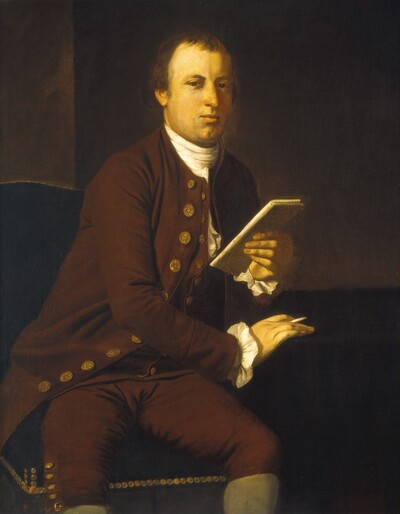
[1] The artist's descendants believed that the portrait was painted for the Fitches' maternal uncle, Dr. James Lloyd, a prominent Boston surgeon [Martha Babcock Amory, _The Domestic and Artistic Life of John Singleton Copley, R.A._ (Boston, 1882), 195; Frank W. Bayley, _The Life and Works of John Singleton Copley_ (Boston, 1915), 104; and Jules David Prown, _John Singleton Copley_ 2 vols. (Cambridge, Mass., 1966), 2:419]. The donors also believed this (letter from Katharine Abbott Batchelder, 27 February 1974, in NGA curatorial files). Earlier owners, however, believed it was painted for Lloyd's son, who later served as United States Senator from Massachusetts. When M. Woolsey Borland placed the painting on loan at the Museum of Fine Arts, Boston, in 1898, for example, he wrote that it was sent to my grand-uncle Senator James Lloyd in Boston." (Letter of 19 December 1898, Museum of Fine Arts, Boston, archives) Dr. Lloyd is listed in the _Dictionary of American Biography_ 6, 333; for his descendants see _Papers of the Lloyd Family of the Manor of Queen's Village, Lloyd's Neck, Lond Island, New York, 1654-1826_, edited by Dorothy C. Barck, 2 vols. (New York, 1927), 2:889, 895, 899.
[2] Katharine Abbott Batchelder, letter, 27 February 1974, in NGA curatorial files.
[3] Batchelder 1974, letter; M. Woolsey Borland's death date is found in the _Social Register, Boston_ (New York, 1910), 165.
[4] The birth-dates of Mrs. Abbott and her daughters are found in Nelson Otis Tiffany, _The Tiffanies of America; History and Genealogy_ (Buffalo, 1901?), 37; Mrs. Lothrop's death is listed in "Deaths 1993," an appendix to Social Register Association, _Social Register 1993_, New York, 1992, 21. Other dates were obtained in conversations with Gordon Abbott III in 1988.
Accession Number
1960.4.1
Medium
oil on canvas
Dimensions
overall: 257.8 x 340.4 cm (101 1/2 x 134 in.) | framed: 283.9 x 365.8 x 11.1 cm (111 3/4 x 144 x 4 3/8 in.)
Classification
Painting
Credit Line
Gift of Eleanor Lothrop, Gordon Abbott, and Katharine A. Batchelder
Tags
Painting Neoclassical & Romantic (1751–1850) Oil Painting Canvas American
Background & Context
Background Story
Colonel William Fitch and His Sisters Sarah and Ann Fitch from 1800-1801 is a triple portrait from Copley's London period, depicting a British military officer and his two sisters in a composition that demonstrates Copley's continued mastery of the group portrait format. The 1800-1801 date places this in the period when Copley was attempting to balance his history painting ambitions with the portrait commissions that paid the bills, and the painting shows him applying the compositional sophistication of his history paintings to what is essentially a domestic group portrait. The colonel's military uniform provides the compositional anchor, while his sisters provide the domestic context that softens the military subject.
Cultural Impact
Copley's London group portraits demonstrate his ability to combine the intimate observation of his American portraiture with the compositional sophistication he learned from studying European painting. The Fitch portrait group is simultaneously a military portrait (the colonel in uniform), a domestic portrait (the sisters in fashionable dress), and a group composition (three figures arranged in a triangular pattern). The painting proves that Copley's American gifts—his ability to observe character and to arrange figures in space—survived the transition to London.
Why It Matters
Colonel William Fitch and His Sisters is Copley's American observation meeting European composition: a military officer and his two sisters arranged in a triangular group that combines military portraiture with domestic intimacy. The painting proves that Copley's gifts survived the Atlantic crossing—the same eye for character that painted Boston merchants could also paint English colonels.