Provenance
By inheritance from her brother to Miss Harriet Patterson Winslow [d. 1964], Washington, D.C., as _Fountains Abbey_ by George Smith of Chichester; gift 1959 to NGA.
Accession Number
1959.1.1
Medium
oil on canvas
Dimensions
overall: 65.9 x 91.6 cm (25 15/16 x 36 1/16 in.) | framed: 80 x 105.4 x 6.9 cm (31 1/2 x 41 1/2 x 2 11/16 in.)
Classification
Painting
Credit Line
Gift of Miss Harriet Winslow
Tags
Painting Neoclassical & Romantic (1751–1850) Oil Painting Canvas British
Background & Context
Background Story
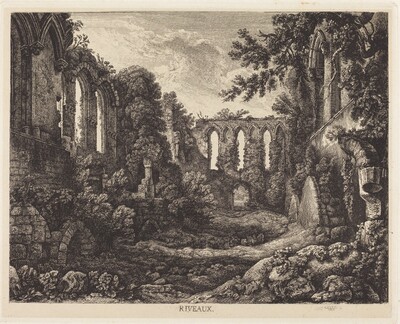
Easby Abbey, near Richmond is a work by George Cuitt the Younger dating to approximately 1821-1854, depicting one of the most celebrated monastic ruins in Yorkshire. Easby Abbey, formally known as the Abbey of St. Agatha, was founded in 1152 by Premonstratensian canons and stands in a picturesque setting on the banks of the River Swale near Richmond, in what is now North Yorkshire. The abbey was dissolved by Henry VIII in 1536 during the Reformation, and its ruins became one of the most frequently depicted subjects in English landscape art. George Cuitt the Younger (1779-1854) was a Yorkshire-born artist who specialized in topographical views and architectural subjects, producing etchings and watercolors that documented the landscapes and historic buildings of northern England with precision and artistic sensitivity. Cuitt was the son of George Cuitt the Elder, also an artist, and the family's involvement in the visual documentation of Yorkshire's architectural heritage represents a local tradition of topographical art that paralleled and complemented the more famous work of nationally known artists. The depiction of Easby Abbey connected Cuitt to a rich artistic tradition that included J.M.W. Turner, who painted the abbey numerous times, as well as countless other artists who were drawn to its romantic ruins. The Premonstratensian abbey at Easby offered artists a scene of great picturesque appeal: substantial architectural remains—including a magnificent refectory, cloisters, and the abbey church—set within lush riverside meadows and framed by the pastoral landscape of Swaledale. The early nineteenth century saw an extraordinary flowering of interest in monastic ruins, driven by the Romantic movement's fascination with the passage of time, the beauty of decay, and the spiritual atmosphere of abandoned sacred spaces. This interest had practical consequences, as it contributed to the preservation movement that would eventually protect many of England's monastic ruins from further destruction.
Cultural Impact
Cuitt's depictions of Yorkshire architecture represented a significant contribution to the visual documentation of England's historic buildings, complementing the work of better-known artists while providing detailed records of structures and landscapes that have since changed. The tradition of depicting monastic ruins helped launch the preservation movement that ultimately protected these sites for future generations, transforming them from convenient quarries into valued national heritage.
Why It Matters
This work matters as part of the rich tradition of English topographical art that documented the nation's architectural heritage, and as evidence of the Romantic movement's engagement with monastic ruins that helped transform public attitudes toward the preservation of historic buildings.