Provenance
The sitter's father, Lorenzo Guernsey Woodhouse [1839-1903], New York; possibly his nephew (the sitter's cousin), Lorenzo E. Woodhouse, New York;[1] the sitter's daughter, Olga Roosevelt Bayne Graves [Mrs. Sidney C. Graves, 1891-1962], Washington, D.C.; gift 1962 to NGA.
[1] He lent the painting to the Brooklyn Museum from 1909 to 1913. According to information supplied by the museum's former curator Axel von Saldern, letter of 5 April 1965 in NGA curatorial files, the portrait was exhibited there under the title "Portrait of a Lady," and lent by Lorenzo E. Woodhouse. It was listed as no. 311 in the 1910 catalogue of paintings.
Accession Number
1962.6.1
Medium
oil on canvas
Dimensions
overall: 162.9 x 94 cm (64 1/8 x 37 in.) | framed: 177.5 x 108.3 cm (69 7/8 x 42 5/8 in.)
Classification
Painting
Credit Line
Gift of Olga Roosevelt Graves
Tags
Painting Impressionist & Modern (1851–1900) Oil Painting Canvas American
Background & Context
Background Story
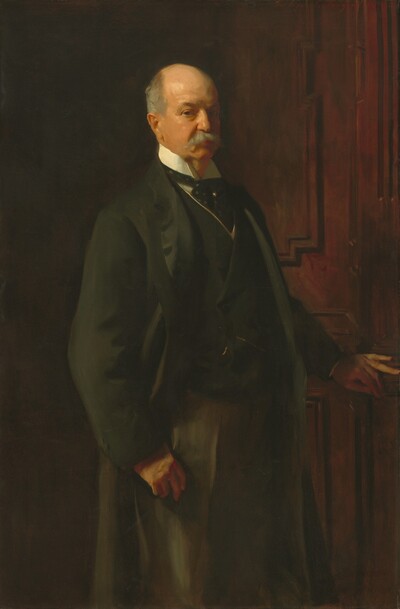
Miss Grace Woodhouse (c. 1890) is another of Sargent's portraits of young women of the Anglo-American elite—figures whose social position and personal style made them ideal subjects for his portrait practice. Sargent's treatment of Miss Woodhouse demonstrates his ability to capture the specific quality of youthful social presence: the self-awareness that comes from being an object of attention, the confidence that comes from social position, and the specific quality of feminine attractiveness that distinguished the young women of the international set. The 1890 date places this during Sargent's most productive London period, when his portrait practice was serving the Anglo-American elite whose social rituals defined the international set. His handling—the rapid brushwork that gave his portraits their characteristic energy, the tonal values that modeled the figure with authority, and the compositional decisions that placed the figure within the space with the casualness that concealed its precision—demonstrates the method that had made him the most sought-after portraitist of his generation. The portrait also documents the fashions, the social conventions, and the specific quality of feminine presentation that defined the international set at the height of its confidence.
Cultural Impact
Sargent's portraits of young women influenced how feminine social presence was represented in elite portraiture, documenting the self-awareness and confidence that social position produced. The portraits influenced fashion and social documentation, preserving the specific quality of feminine presentation at the turn of the century. Miss Grace Woodhouse influenced how youth and social position were visually combined in portraiture.
Why It Matters
This painting matters because it preserves the specific quality of youthful social presence at the turn of the century—with the rapid brushwork and the compositional authority that made Sargent's portraits the definitive record of the international set's social confidence.