Provenance
(Bernheim-Jeune, Paris). Dilenn, Brussels. (Galerie Jacques Dubourg, Paris); sold 9 June 1926 to Chester Dale [1883-1962], New York;[1] bequest 1963 to NGA.
[1] Provenance according to Chester Dale papers; copies in NGA curatorial files.
Accession Number
1963.10.214
Medium
oil on canvas
Dimensions
overall: 54.3 x 64.7 cm (21 3/8 x 25 1/2 in.) | framed: 76.5 x 87.1 cm (30 1/8 x 34 5/16 in.)
Classification
Painting
Credit Line
Chester Dale Collection
Tags
Painting Impressionist & Modern (1851–1900) Oil Painting Canvas French Color: Teal Color: White
Background & Context
Background Story
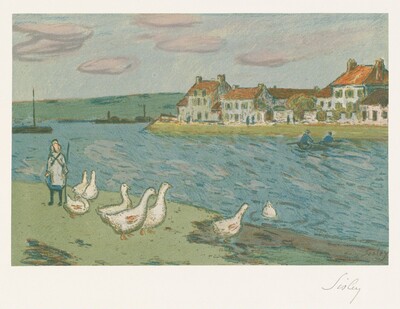
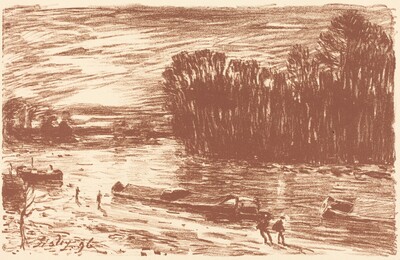
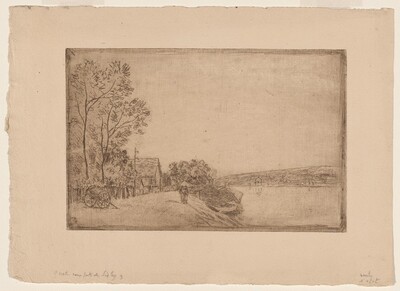
The Banks of the Oise (1877/1878) depicts the river Oise, a tributary of the Seine that flows through the valleys northwest of Paris where several Impressionists worked. Sisley, who specialized in river landscapes, painted the Oise's banks with the patient attention to water, reflection, and riverside vegetation that characterized his entire career. The composition likely combines the river's reflective surface with the sky's reflected light and the bank's structural geometry—the three elements that constitute Sisley's visual alphabet. The Oise was both a working river (barge traffic, fishing, watermills) and a pleasure landscape (riverside walks, boating parties), and Sisley's painting likely acknowledges both dimensions without privileging either. The 1877-78 date places this work during the height of Impressionist activity, when the group was still exhibiting together and challenging the Salon's authority. Sisley's Oise paintings demonstrate that Impressionism was not a single style but a shared commitment to observational painting—the same river produced very different images in the hands of Pissarro, Cézanne (who also painted the Oise), and Sisley. The painting also documents the Oise Valley before industrialization transformed the river's character—a landscape that would be increasingly altered in the following decades.
Cultural Impact
Sisley's Oise paintings influenced how river landscapes were represented in French art, establishing a model for combining topographical accuracy with atmospheric subtlety. The paintings influenced tourism imagery for the Oise Valley and contributed to French regional cultural identity. The Oise subject also influenced later French landscape painters who continued to work in the river valleys around Paris, maintaining the Impressionist tradition of painting the Île-de-France region.
Why It Matters
This painting matters because it represents Sisley's art at its most characteristic: a river landscape rendered with chromatic subtlety and compositional balance that reveals its rewards slowly. Unlike Monet's dramatic effects, Sisley's Oise requires sustained attention, but it rewards that attention with a quiet perfection that more spectacular works rarely achieve. The painting offers a model for how restraint can be as powerful as display.