Provenance
The sitter's husband, Adrian George Iselin [1818-1905], New York and New Rochelle; their daughter, Georgine Iselin [1857-1954], New York and New Rochelle; her grandnephew (the sitter's great-grandson), Ernest Iselin [d. 1968], New York; gift 1964 to NGA.
Accession Number
1964.13.1
Medium
oil on canvas
Dimensions
overall: 153.7 × 93 cm (60 1/2 × 36 5/8 in.) | framed: 181.93 × 122.87 × 12.38 cm (71 5/8 × 48 3/8 × 4 7/8 in.)
Classification
Painting
Credit Line
Gift of Ernest Iselin
Tags
Painting Impressionist & Modern (1851–1900) Oil Painting Canvas American
Background & Context
Background Story
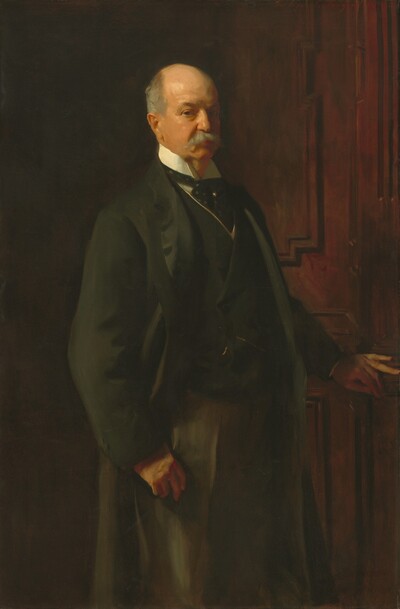
Eleanora O'Donnell Iselin (Mrs. Adrian Iselin) (1888) is one of Sargent's most striking society portraits, depicting a member of New York's social elite with the psychological precision that made his portraits both celebrated and controversial. Mrs. Iselin, the wife of the banker Adrian Iselin, belonged to the nouveaux-riches society that was transforming New York's social landscape in the Gilded Age. Sargent's treatment of her demonstrates the method that made his society portraits so compelling: the figure is not merely a likeness but a character study, with the pose, the expression, and the costume together creating an impression of social authority that goes beyond mere resemblance. The 1888 date places this during Sargent's most productive and most controversial period—the year before the Madame X scandal that would redirect his career from Paris to London. Mrs. Iselin's portrait, with its uncompromising characterization of social power, exemplifies the approach that made Sargent's portraits both sought after and feared: his ability to reveal the personality behind the social facade, and his willingness to let the portrait communicate more than the sitter intended. The portrait also documents the Gilded Age's social structure at its most confident—.social order so secure in its authority that it could commission portraits that revealed its inner dynamics.
Cultural Impact
Sargent's society portraits influenced how Gilded Age social power was represented in art, documenting the elite that industrialization was creating in New York. The portraits influenced later portraitists who similarly sought to reveal character as well as appearance. Mrs. Iselin influenced how female social authority was visually represented, connecting social confidence to psychological presence.
Why It Matters
This painting matters because it captures the social power of Gilded Age New York with the psychological precision that made Sargent's portraits both celebrated and feared—Mrs. Iselin is not merely a likeness but a character study, and the character revealed is the social authority that the new industrial elite was constructing.