Provenance
Richard White, 2d earl of Bantry [1800-1868], County Cork, Ireland, who perhaps bought it in Italy c. 1820; by descent to Mrs. Shelswell-White. (Unspecified dealer, Dublin, as by Pellegrini, in 1955); (David Carritt for Geoffrey Merton, London), 1956.[1] (Thomas Agnew & Sons, London); purchased 1964 by NGA.
[1] The discovery of the series of Tasso paintings, of which this and NGA 1964.21.2 are part, is variously recounted in the early literature (see references). Only Antonio Morassi, "Aggiunta al Guardi: le cinque 'Storie' della Gerusalemme liberata", _Emporium_ 131 (1960): 247; Fern Rusk Shapley, _Catalogue of Italian Paintings_, 2 vols., Washington, D.C., 1979: 1:232; and a few contemporary news accounts, for example, _Giornale del Mattino_ 30 October 1959, mention the "Dublin dealer." The rest report that Carritt discovered them in "the shed of an old house in Ireland."
There is no evidence which of the Bantry residences originally housed the paintings, or when and where they were acquired. An unsubstantiated, and unlikely, rumor that the paintings were once at Versailles is variously reported in the NGA curatorial files. Francis J.B. Watson, "Guardi and England", in _Problemi Guardeschi. Atti del convegno di studi promossi della Mostra dei Guardi. 13-14 settembre 1965_, Venice, 1967: 212, speculated that the earl of Bantry may have acquired the paintings as works by François Boucher (1703-1770).
Accession Number
1964.21.1
Medium
oil on canvas
Dimensions
overall: 250.2 x 459.8 cm (98 1/2 x 181 in.) | framed: 258.1 x 471.5 cm (101 5/8 x 185 5/8 in.)
Classification
Painting
Credit Line
Ailsa Mellon Bruce Fund
Tags
Painting Baroque (1600–1750) Oil Painting Canvas Italian
Background & Context
Background Story
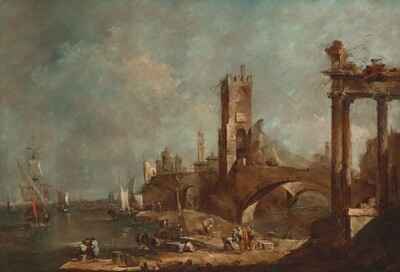
Carlo and Ubaldo Resisting the Enchantments of Armida's Nymphs from 1750-55 is a collaborative painting by Gian Antonio Guardi (1699-1760) and his younger brother Francesco Guardi (1712-1793), depicting an episode from Torquato Tasso's epic poem Gerusalemme Liberata in which the knights Carlo and Ubaldo resist the enchantments of the sorceress Armida's nymphs. The collaborative attribution indicates that both brothers contributed to the painting, with Gian Antonio providing the compositional design and Francesco the atmospheric effect. The Tasso subject was popular in 18th-century Venetian painting because it combined epic narrative with the Rococo taste for enchantment and fantasy.
Cultural Impact
Carlo and Ubaldo Resisting the Enchantments of Armida's Nymphs is important in the history of Venetian Rococo painting because it demonstrates the collaborative working method of the Guardi brothers. The painting combines Gian Antonio's compositional design with Francesco's atmospheric effect, creating a type of Rococo narrative painting that is simultaneously epic in subject and atmospheric in manner—a combination that reflects the Venetian Rococo taste for combining epic narrative with enchantment and fantasy.
Why It Matters
Carlo and Ubaldo Resisting the Enchantments of Armida's Nymphs is the Guardi brothers collaborating on Tasso's epic: an episode from Gerusalemme Liberata rendered with Gian Antonio's compositional design and Francesco's atmospheric effect. The 1750-55 painting demonstrates the collaborative working method and the Venetian Rococo taste for epic narrative combined with enchantment.