
Provenance
Queen Isabel of Castile [d. 1504], castle of Toro, Zamora province. Diego Flores, by 13 March 1505, possibly as agent for Margaret of Austria.[1] Margaret of Austria, Regent of the Netherlands [d. 1530], Mechelen.[2] Jules Quesnet, Paris, by 1904.[3] Private collection, Zurich, from c. 1941;[4] (Feilchenfeldt, Zurich, by 1964); purchased 1965 by NGA.
[1] Francisco Javier Sánchez Cantón, "El retablo de la reina Católica," _Archivo Español de Arte y Arqueología_ 6 (1930): 97-103.
[2] Inventories of 1516 and 1524. André Joseph Ghislain le Glay, _Correspondence de Maximilien Ier et de Marguérite d'Autriche..._, 2 vols., Paris, 1839: 2:481-482.
[3] See _Exposition des primitifs français_, exh. cat., Paris, Musée du Louvre and Bibliothèque Nationale, 1904: no. 111.
[4] Letter of 31 October 1960 from Mrs. Walter Feilchenfeldt, in NGA curatorial files.
Accession Number
1965.1.1
Medium
oil on panel
Dimensions
painted surface: 21.1 x 16.2 cm (8 5/16 x 6 3/8 in.) | overall (panel): 21.3 x 16.7 cm (8 3/8 x 6 9/16 in.) | framed: 35.5 x 31.1 cm (14 x 12 1/4 in.)
Classification
Painting
Credit Line
Ailsa Mellon Bruce Fund
Tags
Painting Renaissance (1400–1599) Oil Painting Panel Painting Netherlandish
Background & Context
Background Story
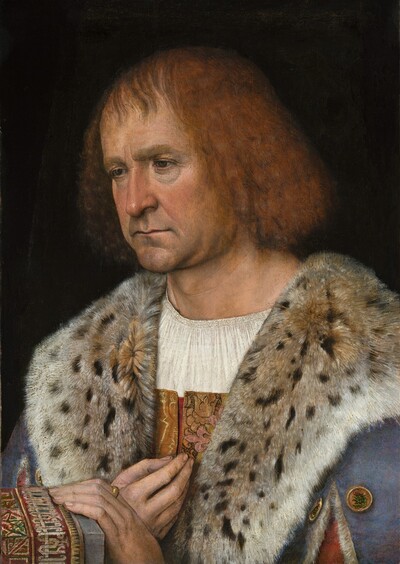
Michel Sittow (c. 1469-1525) was an Estonian-born painter who worked in the Netherlands, Spain, and Denmark, known for the combination of Netherlandish detail and international courtly elegance that distinguishes his best work. The Assumption of the Virgin from c. 1500 depicts the biblical subject in the precise, elegant manner that Sittow developed from his Netherlandish training and his experience as a court painter to Isabella of Castile. The c. 1500 date places this in Sittow's most productive period, when he was producing the devotional paintings and portraits that combine Netherlandish detail with courtly elegance.
Cultural Impact
The Assumption of the Virgin is important in Sittow's oeuvre because it demonstrates the combination of Netherlandish detail and courtly elegance that distinguishes his best work. Sittow's career as a court painter to Isabella of Castile gave his religious paintings the combination of Netherlandish precision and international courtly refinement that makes his work a unique synthesis of Northern and Southern European painting traditions.
Why It Matters
The Assumption of the Virgin is Sittow's Netherlandish precision meets courtly elegance: the biblical subject rendered with the combination of Netherlandish detail and international refinement that he learned as Isabella of Castile's court painter. The c. 1500 painting is a unique synthesis of Northern and Southern European painting traditions.

![Saint Bernard and Saint Catherine of Alexandria with the Virgin of the Annunciation [right panel]](https://api.nga.gov/iiif/e6890364-4d99-4684-a62b-5060ee3c3446/full/400,/0/default.jpg)