Provenance
Andrew Kirkpatrick Cogswell [d. 1887], New Brunswick, New Jersey;[1] his second wife, Virginia Claiborne Latrobe Cogswell, New Brunswick, New Jersey, and Baltimore;[2] her son, John H.B. Latrobe Cogswell [d. 1967]; his half-niece, Mary V.R. Thayer [Mrs. Sigourney Thayer], Washington, D.C.; gift 1968 to NGA.
[1] The provenance was provided by the donor of the painting in an undated memorandum (in NGA curatorial files).
[2] A death date for Virginia Cogswell has not been established. An obituary for her husband in the _New York Daily Tribune_, 14 February 1887, states that she was then "at the point of death"; however, according to Mary Thayer (undated memorandum in NGA curatorial files), Virginia Cogswell and her son John "returned to Baltimore to live" following the death of Judge Cogswell.
Accession Number
1968.7.1
Medium
oil on canvas
Dimensions
overall: 25.4 x 39.9 cm (10 x 15 11/16 in.) | framed: 38.1 x 52.1 x 6.4 cm (15 x 20 1/2 x 2 1/2 in.)
Classification
Painting
Credit Line
Gift of Mrs. Sigourney Thayer
Tags
Painting Impressionist & Modern (1851–1900) Oil Painting Canvas American
Background & Context
Background Story
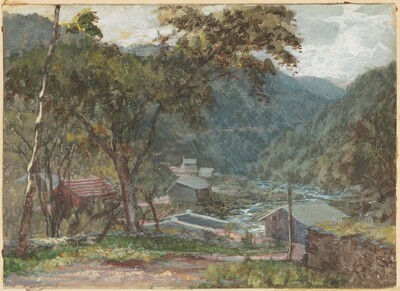
Landing at Sabbath Day Point (c. 1853) depicts a specific location on Lake George in upstate New York—one of the Hudson River School's most frequently painted destinations. Sabbath Day Point, a promontory on the lake's western shore, was named for its use as a Sunday rest stop by travelers navigating the lake during the colonial period. Kensett's treatment captures the lake's characteristic clarity—Lake George's exceptional water quality and visibility made it a subject ideally suited to Luminist technique. The 'landing' of the title suggests human activity—boats, docks, and the comings and goings of lake travel—yet Kensett's Luminist approach subordinates human presence to atmospheric effect. The year 1853 was a productive one for Kensett, who was painting lake and coastal subjects with increasing confidence and developing the Luminist technique that would define his mature work. Lake George was accessible from New York City by railroad and steamboat, making it a destination for both artists and tourists. Kensett's painting captures the lake before the major resort development that would transform its shores in the Gilded Age—documenting a more modest, rural Lake George that would soon disappear.
Cultural Impact
Kensett's Lake George paintings influenced how the lake was represented in American art and culture, establishing visual conventions that contributed to Lake George's identity as the 'Queen of American Lakes.' The paintings influenced tourism for the Lake George region and informed the cultural understanding of upstate New York as a landscape of natural beauty. Kensett's Luminist approach to lake painting influenced later American artists who similarly sought to capture water's reflective and transparent qualities.
Why It Matters
This painting matters because it documents a specific American landscape at a specific moment—the Lake George of the 1850s, before Gilded Age resort development transformed its shores. Kensett's serene treatment captures the lake's essential character—its clarity, its beauty, its capacity for contemplative experience—in a way that later, more developed iterations of the same subject cannot match.