Provenance
Dieterle, Paris. Paul Gerson, New York. Harold Sidney Harmsworth, 1st Viscount Rothermere [d.1940]; (his sale, Christie's, London, 19 December 1941, no. 34); purchased by (Arthur Tooth and Sons, London and Paris) for Capt. Edward H. Molyneux [1891-1974], Paris, by 1952;[1] sold 15 August 1955 to Ailsa Mellon Bruce [1901-1969], New York; bequest 1970 to NGA.
[1] According to annotated copy of the sales catalogue in NGA curatorial files. This is almost certainly the picture recorded as Boudin, "At Deauville" in Arthur Tooth records, volume XXI, London Branch Stock Inventory, p. 85 (Getty Research Institute, Los Angeles, accession no. 860679), which was sold with another Rothermere picture to Molyneux on the day of the Christie's sale.
Accession Number
1970.17.12
Medium
oil on wood
Dimensions
overall (including surrounding strips of wood, approx. .005): 27 x 49.1 cm (10 5/8 x 19 5/16 in.) | framed: 41.3 x 63.3 x 9.5 cm (16 1/4 x 24 15/16 x 3 3/4 in.)
Classification
Painting
Credit Line
Ailsa Mellon Bruce Collection
Tags
Painting Impressionist & Modern (1851–1900) Oil Painting French
Background & Context
Background Story
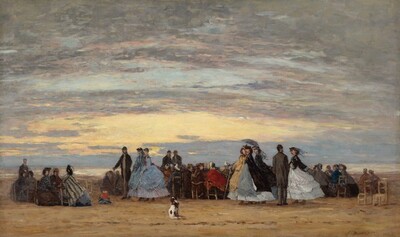
Beach at Trouville, painted in 1864-1865, is one of Eugene Boudin most celebrated works and a painting that captures the fashionable beach resort at its most characteristic moment. Well-dressed Parisians stroll along the sand under parasols, their crinolines and top hats punctuating a landscape of sand, sea, and cloud that is the essence of the Normandy coast.
Boudin painted Trouville repeatedly throughout the 1860s, producing the body of work that established the beach resort as a major subject in French painting. His Trouville scenes, painted on small panels that he could carry and complete on the spot, capture the effects of light and weather with a directness that anticipates Impressionism.
The painting was executed at the same resort where Monet would paint his breakthrough canvas Impression, Sunrise in 1872. Boudin Trouville, with its rapid notation of figures against sand and sky, is the direct ancestor of Monet revolutionary work. Monet himself acknowledged his debt, writing that he owed everything to Boudin, who taught him to see.
The painting most modern feature is its treatment of the figures as elements of color rather than individual portraits. Each parasol, each dress, each hat is a note of color in a larger composition of atmosphere. Boudin beach-goers are not people but brushstrokes - and the painting is not about them but about the light that illuminates them and the sky that arches above them.
Cultural Impact
Boudin Trouville paintings created a new genre of beach scene that directly influenced the development of Impressionism. His demonstration that the transient effects of light and weather on a populated beach could be captured in paint established the method that Monet would transform into the most revolutionary painting of the 19th century.
Why It Matters
This painting captures the moment when the beach became art: a stretch of Normandy sand, a party of fashionables, and above them a sky of towering clouds that is the true subject. Boudin Trouville is the birthplace of Impressionism - the place where the modern painter learned to look directly at the world and paint what he saw.