Provenance
Harold Sidney Harmsworth, 1st viscount Rothermere [d.1940]; (his sale, Christie, Manson & Woods, London, 19 December 1941, no. 37); purchased by (Arthur Tooth and Sons, London and Paris) for Capt. Edward H. Molyneux [1891-1974], Paris;[1] sold 15 August 1955 to Ailsa Mellon Bruce [1901-1969], New York; bequest 1970 to NGA.[2]
[1] Arthur Tooth records, volume XXI, London Branch Stock Inventory, p. 85 (Getty Research Institute, Los Angeles, accession no. 860679). There is a label from "Arthur Tooth & Sons" on the reverse of the painting, on the top bar of the cradle.
[2] According to the Ailsa Mellon Bruce notebook, now in NGA archives; copy in NGA curatorial files.
Accession Number
1970.17.14
Medium
oil on wood
Dimensions
overall: 11 x 25.6 cm, 0.3 cm (4 5/16 x 10 1/16 in., 1/8 in.) | framed: 21.6 x 36.2 x 2.9 cm (8 1/2 x 14 1/4 x 1 1/8 in.)
Classification
Painting
Credit Line
Ailsa Mellon Bruce Collection
Tags
Painting Impressionist & Modern (1851–1900) Oil Painting French
Background & Context
Background Story
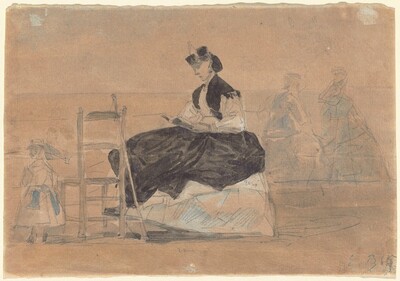
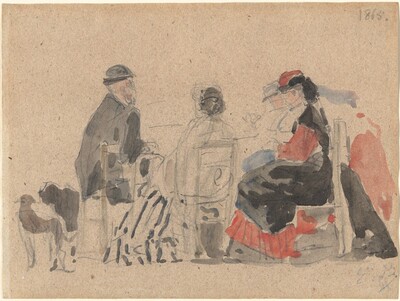
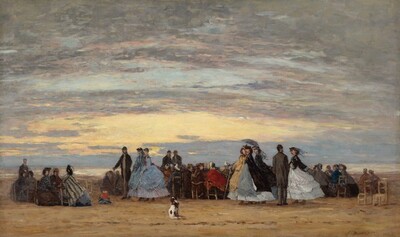
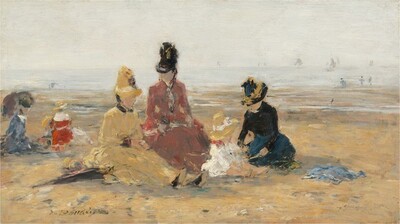
The Beach (1877) depicts theNormandy seaside at a moment when beach culture was transforming from therapeutic exercise to fashionable leisure. The 1870s saw the rapid expansion of seaside tourism along the Normandy coast, as rail connections made previously remote beaches accessible to Parisian visitors. Trouville, Deauville, and other coastal towns were developing from fishing villages into fashionable resorts, and Boudin's painting captures this transformation from a position of intimate local knowledge. The beach itself—its physical character, its relationship to the town behind it, and its role as the site where social classes mixed—provided Boudin with subjects that combined landscape observation with social commentary. His beachgoers—.mix of local fisherfolk and visiting Parisians—represented the social complexity of resorts where different classes occupied the same landscape. Boudin's treatment of the beach's most characteristic visual effect—the light that reflected from sand, sea, and sky in a unified atmospheric field—demonstrates why he was known as the king of the skies. The Normandy coast's distinctive light, where maritime and terrestrial atmospheres merge, provided the conditions for atmospheric painting that Boudin exploited throughout his career.
Cultural Impact
Boudin's beach paintings influenced how seaside leisure was represented in French art, establishing visual conventions for beach scenes that influenced the Impressionists and later painters. The paintings documented the development of seaside tourism at a specific historical moment, providing visual evidence of the social and economic transformation that produced modern beach culture. The paintings also influenced fashion illustration by depicting the elaborate costumes that 19th-century beachgoers wore.
Why It Matters
This painting matters because it documents the birth of modern beach culture with the informed attention of someone who watched it happen. Boudin's beach paintings capture the moment when the seaside shifted from a therapeutic resource to a social stage, and they do so from the perspective of a local observer who understood both the landscape and the social forces that were transforming it.