Provenance
Adolphe A. Tavernier, Paris; (his sale, by Bernheim-Jeune, experts, Paris, 23 March 1903, no. 14). Albert Pontremoli, London; (Pontremoli sale, Christie's, London, 23 June 1906, no. 44); purchased by (Bernheim-Jeune, Paris).[1] (Jacques Lindon, New York); sold 4 February 1947 to Ailsa Mellon Bruce [1901-1969], New York;[2] gift 1970 to NGA.
[1] According to Robert Schmit, _Eugène Boudin, 1824-1898_, 3 vols., Paris, 1973: 2:no. 1510.
[2] Receipt of sale from Lindon to Mrs. Bruce, dated 4 February 1947, in NGA curatorial files.
Accession Number
1970.17.15
Medium
oil on wood
Dimensions
overall: 24.8 x 36.2 cm (9 3/4 x 14 1/4 in.) | framed: 41.6 x 52.4 x 5.2 cm (16 3/8 x 20 5/8 x 2 1/16 in.)
Classification
Painting
Credit Line
Ailsa Mellon Bruce Collection
Tags
Painting Impressionist & Modern (1851–1900) Oil Painting French
Background & Context
Background Story
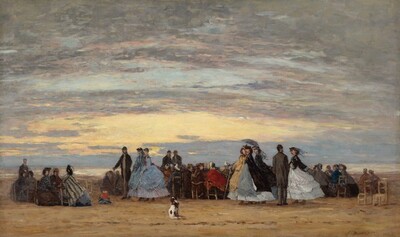
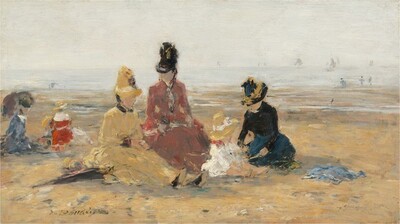
Women on the Beach at Berck, painted in 1881, depicts a group of women - likely fishwives or shrimp-gatherers - walking along the vast flat beach at Berck-sur-Mer in northern France. The painting captures the distinctive atmosphere of the Pas-de-Calais coast: flat sands stretching to a distant horizon, under a sky of towering grey and white clouds.
Berck was a fishing village that became a fashionable resort in the late 19th century, known for its healthy air and its wide beaches. Boudin painted there repeatedly, drawn by the quality of the light and the drama of the skies. His Berck paintings are among his most atmospheric works, demonstrating his ability to find beauty in even the most austere coastal landscapes.
The painting exemplifies Boudin's signature approach: the figures are rendered as rapid notations of color and movement rather than individual portraits, while the sky and its clouds receive the most detailed and loving attention. The women's dark dresses and white caps create a rhythm of dark and light against the pale sand, echoing the larger rhythms of cloud and shadow across the sky.
Cultural Impact
Boudin's Berck paintings documented a traditional fishing culture that was being transformed by tourism, and his work preserves the visual character of a coastline that has changed dramatically since his time. His treatment of the working beach as a subject for serious landscape painting influenced the Social Realists and the painters of the Channel coast.
Why It Matters
This painting captures Boudin's democratic vision: the same careful attention to sky and light that he brought to the fashionable beaches of Deauville he here devotes to the working women of Berck. The sky, as always in Boudin, is the great equalizer - vast, beautiful, and indifferent to the social status of those who walk beneath it.