Provenance
Probably purchased through (Ambroise Vollard [1866-1939], Paris) by Egisto Fabbri [1866-1933], Florence; acquired through (Paul Rosenberg, Paris) February 1938 by Marie N. Harriman [1903-1970] and W. Averell Harriman [1891-1986], New York [Marie Harriman Gallery]; W. Averell Harriman Foundation; gift 1972 to NGA.[1]
[1] According to Harriman collection records in NGA curatorial files.
Accession Number
1972.9.1
Medium
oil on canvas
Dimensions
overall: 73 x 92.5 cm (28 3/4 x 36 7/16 in.) | framed: 102.9 x 121.9 x 11.4 cm (40 1/2 x 48 x 4 1/2 in.)
Classification
Painting
Credit Line
Gift of the W. Averell Harriman Foundation in memory of Marie N. Harriman
Tags
Painting Impressionist & Modern (1851–1900) Oil Painting Canvas French
Background & Context
Background Story
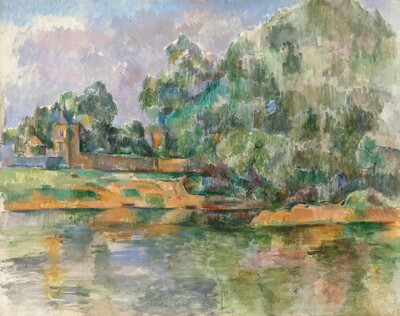
At the Water's Edge (c. 1890) depicts figures at the boundary between land and water—a subject that combined Cézanne's landscape practice with his interest in the human figure within natural settings. The water's edge, where the reflective surface of a lake or river met the solid ground, provided Cézanne with a compositional problem that his constructive method was uniquely equipped to solve: how to render the transition between two completely different surfaces—reflective water and opaque land—without relying on the linear conventions that traditional landscape painting used. The 1890 date places this during Cézanne's most productive period, when his constructive method was reaching its fullest development and when younger painters were beginning to recognize his significance. His treatment of the water's edge likely employs the patch-based method that distinguished his mature work: both water and land are built from the same kind of color patches, with the difference between them maintained through chromatic and tonal relationships rather than through linear boundaries. The figures at the water's edge—bathers in the tradition that Cézanne's Great Bathers series would define—provide the human element that connects the landscape to the figurative tradition. The painting also demonstrates Cézanne's ability to find compositional interest in the simplest natural settings—a patch of shore, a body of water, and the figures who move between them.
Cultural Impact
Cézanne's water-edge paintings influenced how the boundary between land and water was represented in Post-Impressionist art, replacing conventional descriptive techniques with constructive chromatic methods. The paintings influenced later landscape painters who similarly sought to render transitional surfaces without relying on line. The bather subject influenced the development of the great Bathers series that would become Cézanne's most celebrated contribution to figure painting.
Why It Matters
This painting matters because it captures the water's edge—the boundary between reflection and substance—with the constructive method that was Cézanne's most important contribution to painting, arguing that representation is a matter of construction rather than of description, and that the artist builds rather than records visual experience.