Provenance
(Ambroise Vollard [1866-1939], Paris), by 1895; acquired by Pierre-Auguste Renoir [1841-1919], Cagnes; re-purchased by (Ambroise Vollard, Paris), by 1912;[1] sold to Dr. Gottlieb Friedrich Reber [1880-1959], Barmen, Germany, and Lausanne, by 1913;[2] sold May 1931 to Marie N. Harriman [1903-1970] and W. Averell Harriman [1891-1986], New York [Marie Harriman Gallery];[3] W. Averell Harriman Foundation, New York; gift 1972 to NGA.
[1] The early provenance of the painting is described in the literature in different ways: that Cezanne "may have given" it to Renoir (_Cézanne_, exh. cat., Philadelphia Museum of Art, 1996: no. 65), or that Mme Renoir purchased the painting from Vollard (John Rewald, _The Paintings of Paul Cézanne. A Catalogue Raisonné_, 2 vols., New York, 1996: 1:no. 456).
[2] Several sources, including the Harriman collection records (in NGA curatorial files) include the Paris dealer Paul Rosenberg in the provenance either before or after Reber's name. However, a shipping receipt dated 8 July 1912 in the Vollard archives lists three paintings sent to Reber, including "Cezanne baigneuses" that is probably _The Battle of Love_ (kindly provided by Jayne Warman, see correspondence of January 2006 in NGA curatorial files). The painting was exhibited with Reber's collection in 1913 in Darmstadt and Berlin.
[3] According to Harriman collection records, in NGA curatorial files.
Accession Number
1972.9.2
Medium
oil on canvas
Dimensions
overall: 38 x 46 cm (14 15/16 x 18 1/8 in.) | framed: 55.9 x 63.5 x 8.9 cm (22 x 25 x 3 1/2 in.)
Classification
Painting
Credit Line
Gift of the W. Averell Harriman Foundation in memory of Marie N. Harriman
Tags
Painting Impressionist & Modern (1851–1900) Oil Painting Canvas French
Background & Context
Background Story
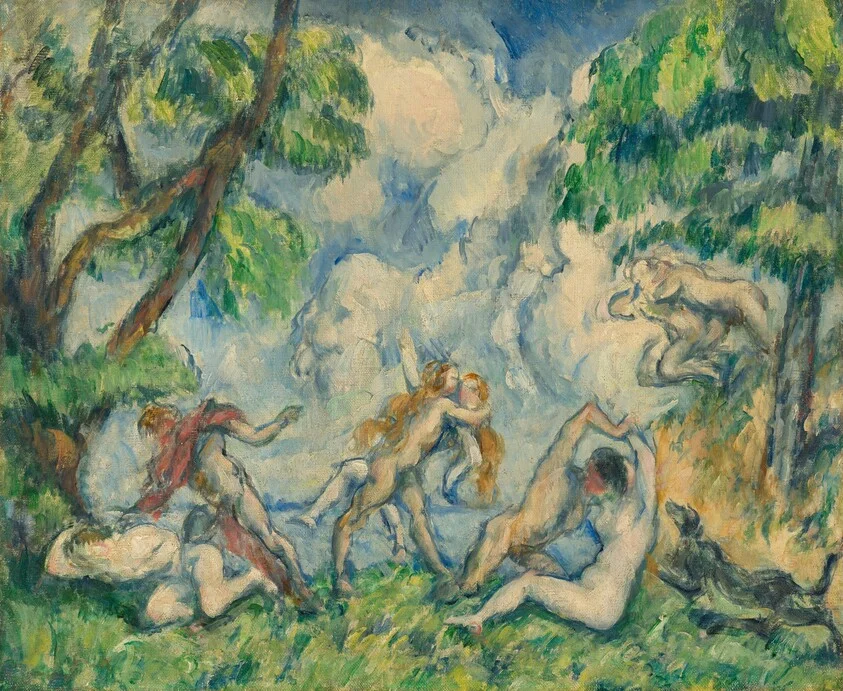
The Battle of Love (c. 1880) is an unusual work in Cézanne's oeuvre—a figurative composition with mythological subject matter that connects the artist to the European tradition he simultaneously inherited and transformed. The battle of love, drawn from classical mythology, provided Cézanne with the opportunity to work within the Academic tradition of mythological painting while deploying the constructive method that would eventually replace it. The 1880 date places this during Cézanne's most experimental period, when he was working through the relationship between his Impressionist inheritance and the more structured approach that would define his mature work. The mythological subject—the struggle between figures representing love's power—allowed Cézanne to explore the figure in motion within a composition that demanded both narrative clarity and formal coherence. His treatment of the battling figures likely shows his characteristic method developing: the bodies are not rendered with the smooth modelling of Academic tradition but are beginning to show the patch-based construction that would characterize his mature figure painting. The painting also reveals Cézanne's engagement with the museum tradition: he studied the Old Masters in the Louvre throughout his career, and The Battle of Love demonstrates his ability to work within the tradition they represented while developing the method that would undermine it.
Cultural Impact
Cézanne's mythological paintings influenced how the relationship between tradition and innovation was understood in Post-Impressionist art, demonstrating that revolutionary methods could serve traditional subjects. The paintings influenced later artists who similarly worked within the mythological tradition while deploying modern techniques. The Battle of Love influenced how Cézanne's development was understood, documenting his engagement with the Academic tradition his mature work would replace.
Why It Matters
This painting matters because it demonstrates that Cézanne's revolutionary method developed within and against the European tradition rather than outside it—the Battle of Love is simultaneously a mythological painting in the Academic tradition and a Post-Impressionist work that undermines that tradition's conventions, arguing that artistic innovation grows from engagement with the past rather than from its rejection.