Provenance
Probably acquired through (Ambroise Vollard [1866-1939], Paris) by Egisto Fabbri [1866-1933], Florence, by 1920;[1] by whom sold c. 1928 to (Paul Rosenberg et Cie., Paris).[2] Marius de Zayas [1880-1961], and his wife Virginia Harrison, New York, by c. 1930; by inheritance to his wife; (Zayas sale, Parke-Bernet Galleries, New York, 14 October 1965, no. 92); Mr. Paul Mellon, Upperville, VA; gift 1973 to NGA.
[1]Published in article on Fabbri collection in _Daedalo_, 1920. [2]See John Rewald, _The Paintings of Paul Cézanne: a Catalogue Raisonné_, New York, 1996, no. 438, regarding the dispersal of the Fabbri collection.
Accession Number
1973.68.1
Medium
oil on canvas
Dimensions
overall: 65 x 81.3 cm (25 9/16 x 32 in.) | framed: 84.4 x 100.3 x 5.7 cm (33 1/4 x 39 1/2 x 2 1/4 in.)
Classification
Painting
Credit Line
Collection of Mr. and Mrs. Paul Mellon
Tags
Painting Impressionist & Modern (1851–1900) Oil Painting Canvas French
Background & Context
Background Story
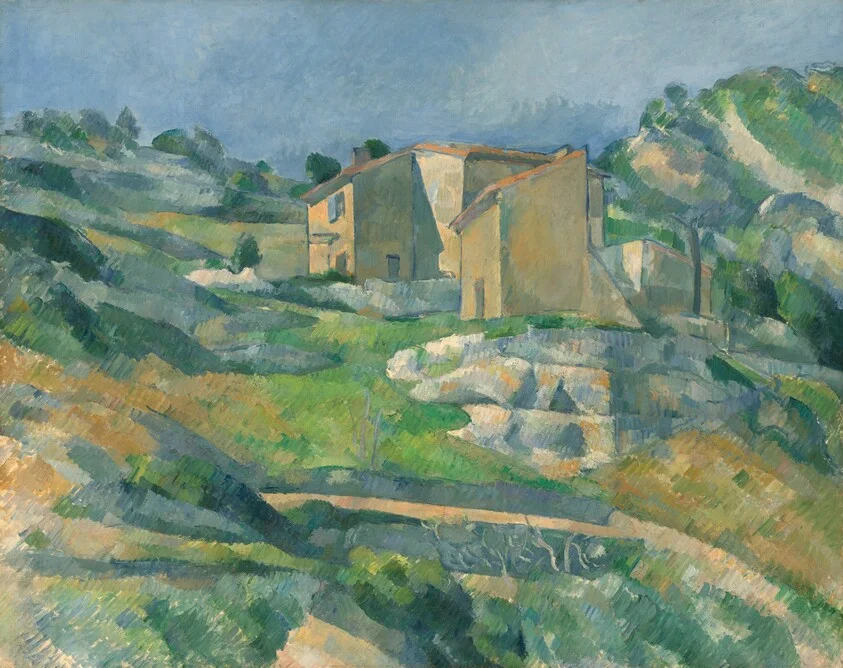
Houses in Provence: The Riaux Valley near L'Estaque (c. 1883) depicts the Provençal landscape that was Cézanne's most important subject—the Mediterranean countryside around Aix-en-Provence and the fishing village of L'Estaque. The Riaux Valley, with its combination of agricultural land, the distinctive architecture of Provençal farmhouses, and the geological formations that gave the landscape its character, provided Cézanne with a subject that combined his interest in architecture and geology within a single composition. The 1883 date places this during the period when Cézanne's constructive method was reaching its fullest development—the patch-based technique that would influence Cubism and beyond was being refined in the Provençal landscape that provided his most characteristic subjects. L'Estaque, where Cézanne painted repeatedly, had become one of the most significant locations in the history of modern art: the village's distinctive combination of sea, architecture, and the Montagne Sainte-Victoire provided subjects that Cézanne explored throughout his career. His treatment of the Provençal houses—their geometric volumes, their characteristic warm colors, and their integration into the landscape's geological structure—demonstrates his ability to find constructive significance in the simplest architectural forms. The houses, built from the same color patches as the landscape surrounding them, are both architecturally specific and chromatically continuous with their setting.
Cultural Impact
Cézanne's L'Estaque paintings influenced how the Provençal landscape was represented in modern art, establishing the region as one of the most significant locations in the development of 20th-century painting. The paintings influenced the Cubists directly—Braque's early Cubist works were painted at L'Estaque specifically because of Cézanne's example. The Riaux Valley subject influenced how landscape and architecture were integrated in Post-Impressionist painting, building both from the same constructive method.
Why It Matters
This painting matters because it demonstrates Cézanne's constructive method at the point where it influenced the most significant revolution in 20th-century art—the Cubist transformation that began at L'Estaque, where Braque and Picasso pursued the implications of Cézanne's patch-based landscape method and produced the paintings that changed the course of modern art.