Provenance
Private collection; (sale, Adam A. Weschler & Son, Washington, D.C., 21-23 May 1982, 3rd day, no. 1316);[1] (Hirschl & Adler Galleries, New York); purchased 14 October 1982 by NGA.
[1] Adam A. Weschler & Son, _18th - 20th Century American, English, Continental and Oriental Furniture and Decorations, Paintings, Silver, Crystal, Porcelains, Antiquities, Rugs, Bronzes, Clocks, Jewelry, Cameo Glass, Art Nouveau, Art Deco, Objects of Virtu, etc._, Washington, D.C., 23 May 1982.
Accession Number
1982.73.1
Medium
oil on wood
Dimensions
overall: 34.8 x 45.6 cm (13 11/16 x 17 15/16 in.) | framed: 63.8 x 74.6 x 8.9 cm (25 1/8 x 29 3/8 x 3 1/2 in.)
Classification
Painting
Credit Line
Gift of The Morris and Gwendolyn Cafritz Foundation
Tags
Painting Impressionist & Modern (1851–1900) Oil Painting American Color: Brown
Background & Context
Background Story
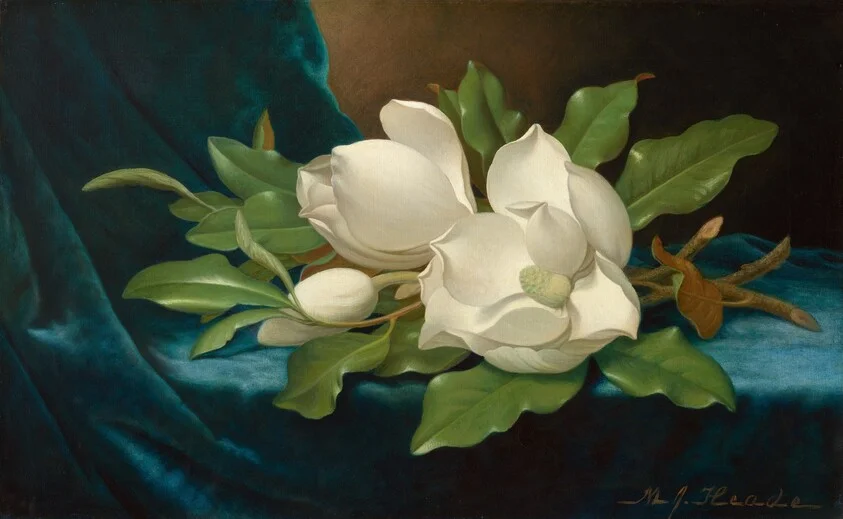
Cattleya Orchid and Three Hummingbirds is one of Heade's most accomplished combinations of his two tropical specialties—orchids and hummingbirds—in a single composition that treats both as objects of scientific attention and aesthetic contemplation. The Cattleya orchid, with its large, ruffled petals, is rendered with Heade's characteristic precision, while the three hummingbirds hover around it with the frozen motion that distinguishes Heade's bird paintings from the more dynamic depictions of Audubon and other naturalist illustrators. The wood panel support gives the paint a luminosity and detail that canvas cannot match, suitable for a work that functions simultaneously as a painting and a scientific illustration.
Cultural Impact
Heade's hummingbird paintings were intended for a projected book titled 'The Gems of Brazil' that was never completed, but the paintings themselves became some of the most distinctive images in American art. Heade's approach combined scientific accuracy with aesthetic refinement in a way that distinguished his work from both pure naturalist illustration and pure landscape painting. The Cattleya orchid and hummingbirds are not just specimens but characters in a compositional drama.
Why It Matters
Cattleya Orchid and Three Hummingbirds is Heade's tropical world in miniature: a single orchid and three hummingbirds rendered with the precision of scientific illustration and the beauty of fine art. The wood panel support gives the paint a luminosity that makes the orchid glow, and the frozen hummingbirds turn flight into stillness—motion preserved for contemplation.