Provenance
Private collection, Bordeaux. (Galerie Schmit, Paris).[1] (Bernheim, Paris); sold 1959 to (Wildenstein and Co., London, New York and Paris);[2] sold 1959 to Paul Mellon [1907-1999], Upperville, VIrginia; gift 1983 to NGA.
[1] Robert Schmit, _Eugène Boudin 1824-1898_, 3 vols., Paris, 1973: 1;no. 191.
[2] Wildenstein acquisition date and source provided in letter dated 14 December 1998, in NGA curatorial files.
Accession Number
1983.1.10
Medium
oil on wood
Dimensions
overall: 41 x 59.3 cm (16 1/8 x 23 3/8 in.) | framed: 62.2 x 81.3 x 6.3 cm (24 1/2 x 32 x 2 1/2 in.)
Classification
Painting
Credit Line
Collection of Mr. and Mrs. Paul Mellon
Tags
Painting Impressionist & Modern (1851–1900) Oil Painting French
Background & Context
Background Story
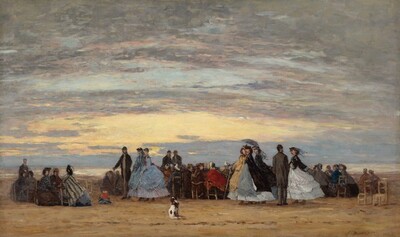
Festival in the Harbor of Honfleur, painted in 1858, depicts the bustling port of Honfleur in Normandy during a local celebration. Flags fly from the masts of sailing ships, crowds gather on the quayside, and the entire scene is bathed in the luminous atmosphere that distinguishes Boudin's finest work. The painting belongs to Boudin's early mature period, when he was developing the plein-air techniques that would influence Monet.
Honfleur was Boudin's hometown and the source of his most intimate knowledge of the Normandy coast. The harbor, with its distinctive 17th-century buildings and its fishing fleet, provided him with subjects throughout his career. This festival scene, with its colorful flags and animated crowds, is one of his most celebratory works - a rare moment of public festivity in an oeuvre more often devoted to quiet observation.
The painting demonstrates Boudin's mastery of the large-scale composition. The harbor, the buildings, the ships, and the sky are all rendered with equal attention, creating a panoramic view that captures the entire visual experience of a Norman festival day. The clouds, as always in Boudin, are the true protagonists: their towering forms organize the composition and determine the quality of light that falls across the entire scene.
Cultural Impact
Boudin's Honfleur paintings documented one of the most picturesque harbors in Normandy and contributed to the town's reputation as an artistic destination. His harbor scenes influenced Monet, who painted his own views of Honfleur, and established the Norman port as a major subject in French landscape painting.
Why It Matters
This painting captures the festive spirit of a Norman harbor while remaining true to Boudin's greatest gift: the observation of sky and light. The flags and crowds are details; the real event is the light that illuminates them, streaming through gaps in the clouds to create the characteristic Norman atmosphere of brightness and transience.