Provenance
(Alex Reid & Lefèvre, London), September 1927, possibly until 1936.[1] L. Lalo; sold 24 May 1937 to (Durand-Ruel, New York and Paris); sold 4 April 1944 to M. Enrico Donat. (Gallimard, Paris). Mme. André Simon, Paris. (Schonemann Galleries, New York).[2] (Thomas J. Gannon, Inc., New York); sold 1952 to Mr. Paul Mellon, Upperville, VA;[3] gift 1983 to NGA.
[1] List dated December 1936, in which Reid & Lefevre request a photograph of the painting from Vrancken at Bignou [their partner] of "Boudin, Personnages sur la plage (Sept 1927)" (Lefevre archives, Hyman Kreitman Research Centre, Tate Britain, London, TGA 2002/11, Box 181).
[2] Provenance according to Robert Schmit, _Eugène Boudin, 1824-1898_, 3 vols., Paris, 1973: 1:no. 433.
[3] Acquisition source and date according to Paul Mellon records in NGA curatorial files.
Accession Number
1983.1.12
Medium
oil on canvas
Dimensions
overall: 38.2 x 61.2 cm (15 1/16 x 24 1/8 in.) | framed: 55.9 x 79.1 x 8.9 cm (22 x 31 1/8 x 3 1/2 in.)
Classification
Painting
Credit Line
Collection of Mr. and Mrs. Paul Mellon
Tags
Painting Impressionist & Modern (1851–1900) Oil Painting Canvas French
Background & Context
Background Story
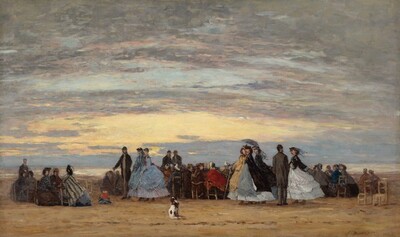
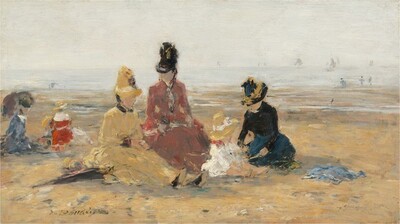
Figures on the Beach (c. 1867/1870) captures the social spectacle of Normandy's seaside resorts during their period of greatest fashionable appeal. The painting's title deliberately emphasizes the figures rather than the landscape—revealing Boudin's understanding that the beach's human activity was as significant as its natural beauty. The late 1860s were the golden age of Normandy seaside culture: the Second Empire's aristocracy and newly wealthy bourgeoisie flocked to Trouville and Deauville, creating a social season that rivaled Paris's. Boudin's figures—rendered with the rapid brushwork that captured their fashionable costumes and casual socializing—are not individual portraits but social types: the parasol-carrying bourgeoise, the top-hatted gentleman, the children with their nurses. This typological approach gives the paintings their sociological value: they document the class structure and social rituals of Second Empire beach culture with the precision of a flâneur who observed without judging. Boudin's atmospheric setting—the sand, the sea, and above all the sky—creates the unified visual field where fashion and landscape merge.
Cultural Impact
Boudin's beach figure paintings influenced how fashionable society was represented in French art, establishing Impressionist conventions for depicting leisure-class social rituals. The paintings influenced fashion history by documenting Second Empire beach costume with the specificity of direct observation. The social types Boudin depicted influenced how French class structure was visually represented during the Second Empire period.
Why It Matters
This painting matters because it documents the social world of France's Second Empire elite at their leisure—a world that the Franco-Prussian War of 1870-71 would destroy. The figures on the beach represent a society enjoying its final season of confidence, recorded by an artist who understood that this world was both beautiful and ephemeral.