Provenance
(Galerie Joseph Allard, Paris). (Piaggi, Paris).[1] purchased 1960 from an anonymous collection in England by (Arthur Tooth and Sons, London, Paris and New York); sold July 1960 to Mr. Paul Mellon, Upperville, VA;[2] gift 1983 to NGA.
[1] Provenance according to Robert Schmit, _Eugène Boudin, 1824-1898_, 3 vols., Paris, 1973: 1:no. 257.
[2] Acquisition source and date according to Paul Mellon records in NGA curatorial files.
Accession Number
1983.1.13
Medium
oil on wood
Dimensions
overall: 31.2 x 47.5 cm (12 5/16 x 18 11/16 in.) | framed: 47.3 x 63.5 cm (18 5/8 x 25 in.)
Classification
Painting
Credit Line
Collection of Mr. and Mrs. Paul Mellon
Tags
Painting Impressionist & Modern (1851–1900) Oil Painting French
Background & Context
Background Story
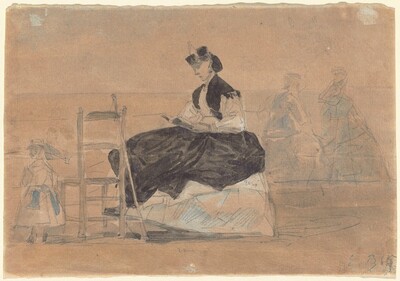
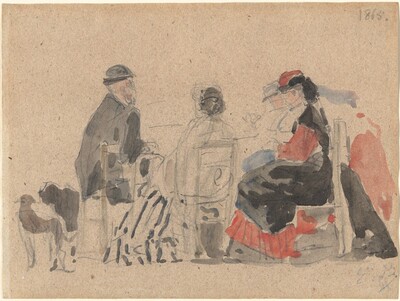
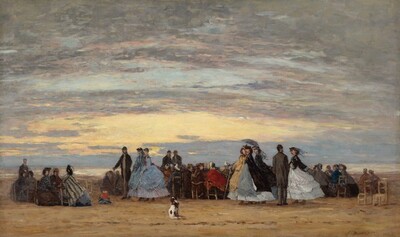
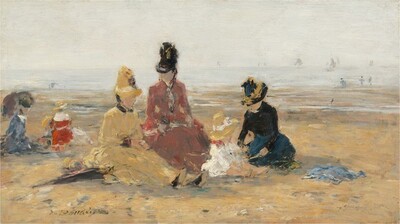
Beach Scene (1862) represents Boudin's early engagement with the seaside subject that would define his career. The year 1862 is significant: this was the period when Boudin was establishing himself as the painter of Normandy's coast, and his beach scenes attracted the attention of both the art establishment and the younger generation of painters who would become the Impressionists. The beach scene's composition—combining figures, architecture, and landscape within a unified atmospheric field—demonstrates the approach that Boudin would refine throughout his career. The figures, whether fashionable visitors or working locals, are integrated into the landscape rather than posed before it, creating compositions where human activity and natural setting form a visual unity. Boudin's handling of the sand—one of his most distinctive surfaces—captures the way beach light reflects from wet sand at low tide, producing a luminous effect that is neither water nor land but something between. This coastal luminosity, which Boudin observed and rendered more effectively than any of his contemporaries, would directly influence Monet's approach to coastal subjects. The painting's 1862 date also connects it to the period when Boudin first met the young Monet in Le Havre, beginning the mentorship that would shape Impressionism's origins.
Cultural Impact
Boudin's early beach scenes influenced the development of Impressionism by demonstrating that outdoor subjects could be painted with both atmospheric sensitivity and social observation. The paintings influenced Monet's approach to coastal subjects, establishing conventions for beach painting that the younger artist would refine. The 1862 beach scene also influenced how Normandy's coast was perceived as an artistic subject.
Why It Matters
This painting matters because it represents the early stage of Boudin's beach painting—the approach that would influence Monet and help launch Impressionism. Without Boudin's beach scenes, the Impressionist engagement with outdoor leisure subjects might have developed very differently. The painting documents the origins of one of art history's most productive mentor-protégé relationships.