Provenance
Charles de Bériot, Paris; (his sale, Hôtel Drouot, Paris, 11 March 1901, no. 1); purchased by Georges Feydeau; (his sale, Hôtel Drouot, Paris, 4 April 1903, no. 3); purchased by (Bernheim-Jeune).[1] (Durand-Ruel, Paris). (Hodebert, Paris). A. Comard, Paris. (Carroll Carstairs Gallery, New York); sold January 1958 to Mr. Paul Mellon, Upperville, VA;[2] gift 1983 to NGA.
[1] Annotated sales catalogues and press clippings in M. Knoedler library and microfiche.
[2] Durand-Ruel through Mellon according to Mellon records in NGA curatorial files.
Accession Number
1983.1.14
Medium
oil on wood
Dimensions
overall: 34.8 x 57.5 cm (13 11/16 x 22 5/8 in.) | framed: 55.6 x 78.1 x 3.8 cm (21 7/8 x 30 3/4 x 1 1/2 in.)
Classification
Painting
Credit Line
Collection of Mr. and Mrs. Paul Mellon
Tags
Painting Impressionist & Modern (1851–1900) Oil Painting French
Background & Context
Background Story
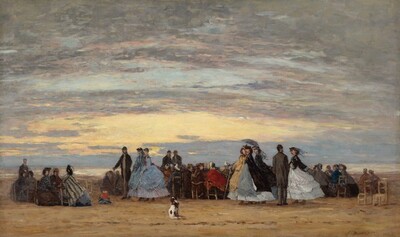
Beach Scene at Trouville (1863) depicts the resort that was Boudin's most consistent subject throughout the 1860s. Trouville-sur-Mer, on the Normandy coast at the mouth of the Touques River, had developed from a fishing village into one of France's most fashionable seaside destinations during the 1850s and 1860s. The year 1863 was significant: the Salon des Refusés had just launched the artistic controversies that would eventually produce Impressionism, and Boudin was painting Trouville with a confidence that attracted critical attention. The beach scene likely depicts the hotel district—the boardwalk area where the grand hotels faced the sea and their guests promenaded on the sand. Trouville's social season—July through September—attracted Paris's elite, and the beach became their social stage. Boudin's treatment captures the beach's characteristic activity: walking, conversing, observing and being observed—the social rituals of leisured society that constituted the beach's primary purpose. His atmospheric handling of the Trouville sky—one of the most-painted skies in French art—creates the luminous canopy under which this social spectacle occurs, connecting human activity to natural conditions in a way that was fundamental to Impressionist thought.
Cultural Impact
Boudin's Trouville beach scenes influenced how French seaside resorts were represented in art, establishing visual conventions for beach painting that persisted through Impressionism to contemporary tourism imagery. The paintings influenced Monet, who painted Trouville in 1870, and the broader Impressionist engagement with leisure subjects. The 1863 Trouville paintings influenced the critical reception of outdoor painting, helping to establish the artistic legitimacy of seaside subjects.
Why It Matters
This painting matters because it captures Trouville at its peak as a fashionable resort—the moment when the fishing village's transformation into a Paris-by-the-sea was complete. Boudin's Trouville documents the social world of the Second Empire at its most confident, recorded by an artist who knew both the resort's beautiful surface and the fishing community's working reality beneath it.