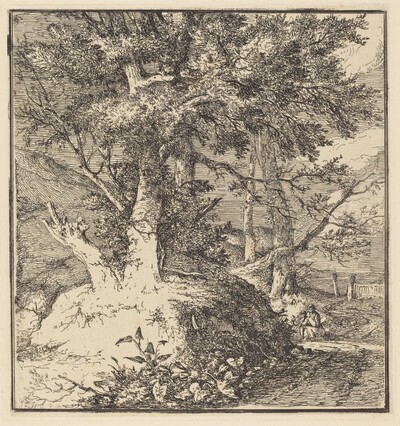
Provenance
Kirkman Hodgson [1814-1879], of Ashgrove, Sevenoaks, Kent; by descent to his son, Robert Kirkman Hodgson [1850-1924], of Gavelacre, Hampshire. H. Darell Brown, London, by 1908;[1] (sale, Christie, Manson & Woods, London, 23 May 1924, no. 17); (Thos. Agnew & Sons, London); sold that same day to the Hon. (later Sir) Arthur Howard [1896-1971].[2] (Thos. Agnew & Sons, London), by 1973;[3] purchased July 1974 by Mr. and Mrs. Paul Mellon, Upperville, Virginia; gift 1983 to NGA.
[1] The painting was included in the _Franco-British Exhibition_, Fine Arts Palace, White City, (London, 1908), no. 73.
[2] Stockbook no. 6277, Thomas Agnew & Sons, London
[3] Letter, Sir Geoffrey Agnew to J. Carter Brown, 8 August 1973, in NGA curatorial files.
Accession Number
1983.1.39
Medium
oil on canvas
Dimensions
overall: 98.4 x 125.7 cm (38 3/4 x 49 1/2 in.) | framed: 122.4 x 149.9 x 9.2 cm (48 3/16 x 59 x 3 5/8 in.)
Classification
Painting
Credit Line
Paul Mellon Collection
Tags
Painting Neoclassical & Romantic (1751–1850) Oil Painting Canvas British
Background & Context
Background Story
John Crome (1768-1821) was an English landscape painter known as the founder of the Norwich School, the group of painters who developed a distinctive regional landscape painting tradition in Norfolk. Moonlight on the Yare from c. 1816-17 depicts the river Yare in Norfolk in the moonlight that Crome painted with the atmospheric subtlety that distinguishes his best work. The Yare was the river that flowed through the Norfolk countryside that Crome painted throughout his career, and the c. 1816-17 date places this in Crome's most productive period, when he was producing the Norfolk landscapes that established the Norwich School as a distinctive regional tradition in English painting.
Cultural Impact
Moonlight on the Yare is important in the history of English landscape painting because it demonstrates the atmospheric subtlety that distinguishes the Norwich School from the more topographical landscape tradition of the 18th century. Crome's moonlight painting shows the same atmospheric effect that the Norwich School was developing independently of the London-based landscape tradition, creating a type of regional landscape painting that was as accomplished as the metropolitan tradition.
Why It Matters
Moonlight on the Yare is Crome's atmospheric Norwich School at its most subtle: the Norfolk river in moonlight rendered with the atmospheric effect that distinguishes the Norwich School from the more topographical landscape tradition. The c. 1816-17 painting shows the regional landscape tradition at its most accomplished.