Provenance
Sold October 1791 by the artist to William Roscoe. (sale, Liverpool, 28 September 1816, no. 154, as _Oedipus devotes to the Infernal Gods His Son Polynices..._); purchased by Baxter.[1] (Maltzahn Gallery, London), in 1973; (Weiss Antiques, Zürich), in 1973; purchased 1974 by Paul Mellon, Upperville, Virginia; gift 1983 to NGA.
[1] Hugh Macandrew, "Henry Fuseli and William Roscoe," _Liverpool Libraries, Museums and Arts Committee Bulletin_ 8 (1959-1960): 22-23, 35 (appendix I, no. 6), as whereabouts unknown since the Roscoe sale in 1816.
Accession Number
1983.1.41
Medium
oil on canvas
Dimensions
overall: 149.8 x 165.4 cm (59 x 65 1/8 in.) | framed: 177.2 x 191.8 x 12.3 cm (69 3/4 x 75 1/2 x 4 13/16 in.)
Classification
Painting
Credit Line
Paul Mellon Collection
Tags
Painting Neoclassical & Romantic (1751–1850) Oil Painting Canvas Swiss Color: Red
Background & Context
Background Story
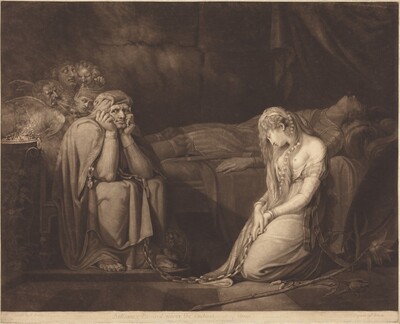
Henry Fuseli (1741-1825) was a Swiss-born painter who worked in London, known for his dramatic, often nightmarish subjects drawn from literature and mythology that made him one of the most distinctive figures in British Romantic art. Oedipus Cursing His Son Polynices from 1786 depicts the episode from Greek tragedy in which Oedipus, having discovered that he has killed his father and married his mother, curses his son Polynices with the violent gesture and dramatic lighting that distinguish Fuseli's treatment of literary subjects. The 1786 date places this in the period when Fuseli was producing his most accomplished literary subjects for exhibition at the Royal Academy.
Cultural Impact
Fuseli's literary subjects are important in the history of British Romantic art because they demonstrate the dramatic, often nightmarish quality that distinguishes British Romantic painting from the more naturalistic tradition of British landscape and portraiture. Oedipus Cursing His Son Polynices shows Fuseli treating a Greek tragedy with the violent gesture and dramatic lighting that he brought to his Shakespeare and Milton subjects, creating a painting that is simultaneously literary and theatrical.
Why It Matters
Oedipus Cursing His Son Polynices is Fuseli's literary drama at its most violent: the Greek tragedy rendered with the dramatic gesture and lighting that distinguish British Romantic painting from the more naturalistic tradition. The 1786 painting shows Fuseli treating Greek tragedy with the same theatrical intensity that he brought to Shakespeare and Milton.