Provenance
Caroline Anne, 4th marchioness of Ely [1856-1917, née Caroline Anne Caithness], Eversley Park, Winchmore Hill, London; (sale, Christie, Manson & Woods, London, 3 August 1917, no. 43); (C. Huggins, London);[1] sold 9 August 1917 to (Thos. Agnew & Sons, Ltd., London, and the dealer H.M. Clark); sold September 1919 to Gaston Neuman, Brussels.[2] (sale, Frederik Muller & Co., Amsterdam, 30 November–6 December 1920, 1st day, no. 1024, bought in); (Frederik Muller & Co., Amsterdam), until at least 1922;[3] possibly (Steinmeyer, Lucerne), in 1923;[4] (Paul Cassirer & Co., Berlin), by 1924.[5] Ignaz Petschek, Aussig (Ústí nad Labem), Czechoslovakia, by 1927; by inheritance to his son, Frank C. Petschek [d. 1963], Aussig (Ústí nad Labem), and New York;[6] by inheritance to his daughters, Elisabeth de Picciotto, New York, and Maria Petschek Smith, Falls Church, Virginia; gift 1986 to NGA.
[1] Letter, 12 November 1952, Christie, Manson & Woods Ltd. to Frank Petschek, copy in NGA curatorial files.
[2] Many details of the provenance, in particular the specifics of Agnew’s ownership and sale of the painting, were researched by Alan Chong, and provided to Arthur Wheelock in letters from 1988 and 1990 (some undated), in NGA curatorial files.
[3] Muller lent the painting to exhibitions in 1921 and 1922.
[4] Steinmeyer’s possible ownership is cited in the files at the Rijksbureau voor Kunsthistorische Documentatie, The Hague; see their letter of 21 April 1951 to Frank Petschek, copy in NGA curatorial files.
[5] Cassirer lent the painting to a 1924 exhibition.
[6] The picture was removed from Czechoslovakia in, or shortly before, 1938 by Frank Petschek.
Accession Number
1986.70.1
Medium
oil on panel
Dimensions
overall: 68 x 90.2 cm (26 3/4 x 35 1/2 in.) | framed: 91.1 x 112.7 x 5.1 cm (35 7/8 x 44 3/8 x 2 in.)
Classification
Painting
Credit Line
Gift of Family Petschek (Aussig)
Tags
Painting Baroque (1600–1750) Oil Painting Panel Painting Dutch
Background & Context
Background Story
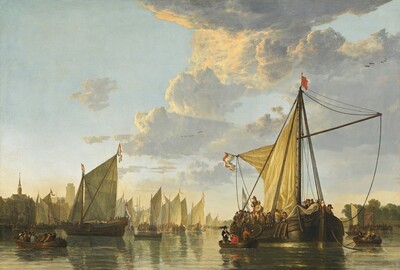
River Landscape with Cows (1645/1650) is an early work showing Cuyp developing the pastoral mode that would make him the most successful Dutch landscape painter among English collectors. The painting depicts cattle watering in a Dutch river landscape—the combination of river, cattle, and expansive sky that became Cuyp's signature. The earlier dating (1645-50) places this before Cuyp's full development of his golden Italianate light, showing him working in a more specifically Dutch landscape tradition while beginning to incorporate the warmer palette that would characterize his mature work. The river—with its reflective surface, its banks providing compositional structure, and its role in Dutch economic and visual life—is the painting's organizing element. The cattle, wading or standing in shallow water, create a focal point that combines animal painting with landscape painting in the distinctive Dutch synthesis. The painting also documents the Dutch landscape at a specific historical moment: the river is a working waterway, the banks show evidence of human management, and the sky's weather suggests the maritime climate that shaped Dutch life and art. This integration of natural observation with economic documentation distinguishes Dutch landscape from the Italian traditions it partly emulated and partly rejected.
Cultural Impact
Cuyp's early river landscapes influenced the development of Dutch pastoral painting, establishing conventions for composing cattle within river landscapes that other Dutch painters adopted. Through the export of Dutch paintings to England in the 18th century, these early works influenced English landscape painters who similarly combined river views with pastoral subjects. The paintings also influenced how Dutch river landscapes were culturally understood—contributing to the image of the Netherlands as a land of rivers, cows, and maritime skies.
Why It Matters
This painting matters because it documents a crucial phase in Cuyp's development—the transition from purely Dutch landscape traditions to the Italianate golden style that would define his mature work and his international influence. For art historians, it provides evidence of how artists synthesize influences rather than simply absorbing them. For general viewers, it offers a beautiful Dutch river landscape in its own right, before Cuyp's later manner achieved its most accomplished form.