Provenance
(sale, Ader Picard Tajan, Paris, 27 April 1987, no. 145); Jody Klotz, New York; (Berry-Hill Galleries, New York), by 1987; purchased 24 February 1989 by NGA.
Accession Number
1989.13.1
Medium
oil on canvas
Dimensions
overall: 86.4 x 139.7 cm (34 x 55 in.) | framed: 123.2 x 174 x 14 cm (48 1/2 x 68 1/2 x 5 1/2 in.)
Classification
Painting
Credit Line
Gift of Guest Services, Inc., in Honor of the 50th Anniversary of the National Gallery of Art
Tags
Painting Impressionist & Modern (1851–1900) Oil Painting Canvas American
Background & Context
Background Story
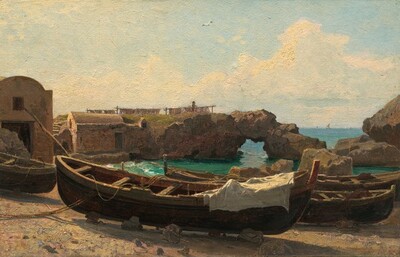
William Stanley Haseltine (1835-1900) was an American landscape painter known for his precisely rendered coastal scenes and rocky shorelines, painted with a geological accuracy that reflected his deep interest in the natural sciences. Natural Arch at Capri from 1871 depicts the famous natural rock arch on the island of Capri with the precision and geological attention that distinguish all of Haseltine's work. The arch is rendered with the care of a geologist as well as a painter—every stratum, every crack, every weathered surface is observed and recorded with the precision that makes Haseltine's landscapes as much scientific documents as aesthetic objects.
Cultural Impact
Haseltine's paintings of Capri and the Italian coast are important in the history of American landscape painting because they combine the precision of geological observation with the aesthetic principles of the Luminist tradition. Natural Arch at Capri demonstrates Haseltine's ability to render geological formations with the accuracy of a naturalist while organizing the composition with the aesthetic sensibility of a Luminist painter—the clear light, the precise drawing, and the careful attention to surface texture that define the Luminist tradition.
Why It Matters
Natural Arch at Capri is Haseltine's geology as Luminism: the famous rock arch rendered with the precision of a naturalist and the clear light of a Luminist painter. The painting demonstrates that geological accuracy and aesthetic beauty are not incompatible—the same careful observation that records every stratum and every crack also creates a composition of luminous clarity.