Provenance
Susan Macdowell Eakins [Mrs. Thomas Eakins, 1851-1938], Philadelphia; her estate; (Babcock Galleries, New York); (Garelick Gallery, Detroit); Marshall M. Miller, Huntington Woods, Michigan; Peter H. Brady, Washington, D.C., by 1977.[1] (Middendorf/Lane, Washington, D.C.), in 1979.[2] (sale, Christie, Manson & Woods, New York, 24 April 1981, no. 92);[3] (Hirschl & Adler Galleries, New York); sold 1982 to John Wilmerding, Washington, D.C.; gift 1991 to NGA.
[1] Phyllis D. Rosenzweig, _The Thomas Eakins Collection of the Hirshhorn Museum and Sculpture Garden_, Washington, D.C., 1977: 297.
[2] The painting appears in a Middendorf/Lane advertisement in the October 1979 issue of _Art News_.
[3] The painting is not recorded in the price list for the 1981 sale, so it was perhaps acquired privately by Hirschl and Adler after the auction.
Accession Number
1991.34.1
Medium
oil on canvas
Dimensions
overall: 46.3 x 36.2 cm (18 1/4 x 14 1/4 in.) | framed: 63.5 x 53.3 x 8.3 cm (25 x 21 x 3 1/4 in.)
Classification
Painting
Credit Line
Gift of John Wilmerding, in Honor of the 50th Anniversary of the National Gallery of Art
Tags
Painting Early Modern (1901–1950) Oil Painting Canvas American
Background & Context
Background Story
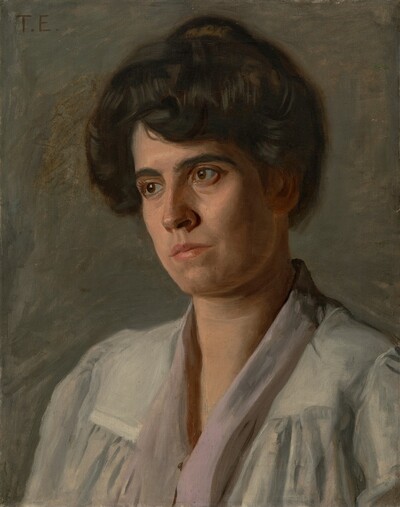
The Chaperone, painted around 1908 near the end of Eakins's career, depicts a social scene involving a chaperone—the adult woman who supervised young unmarried women in public settings according to the social conventions of the late Victorian and Edwardian eras. The subject reflects Eakins's lifelong interest in the social customs that govern human behavior, particularly the codes governing gender, propriety, and public appearance. The chaperone system was a direct product of the same social anxieties about gender and the body that had led to Eakins's own scandal—he had been fired from the Pennsylvania Academy for allowing mixed-gender nude life drawing classes. The irony of painting a chaperone—a figure whose function was to prevent exactly the kind of unmediated encounter with the body that Eakins championed—would not have been lost on the artist. The painting likely presents the chaperone as a study in social architecture: the figure enforces boundaries, mediates between the public and private self, and ensures that propriety is maintained even in potentially compromising situations. Eakins's treatment is characteristically direct: he paints the social situation as he sees it, without the sentimentality or moral judgment that the subject might invite from a lesser artist.
Cultural Impact
The Chaperone influenced how American social customs were represented in art, contributing to a tradition of documenting the codes and rituals of upper-class society. Eakins's treatment—neither celebrating nor condemning the chaperone system—established a precedent for socially observant painting that influenced later American Realist painters. The painting also contributed to the cultural history of American courtship and gender relations.
Why It Matters
This painting matters because it captures a social convention—the chaperone system—at the precise moment of its historical decline. By 1908, chaperones were becoming increasingly optional as American women gained social autonomy. Eakins's painting documents the old system with the same meticulous attention he brought to documenting rowing techniques or surgical procedures—treating a social convention as a technical subject worthy of precise observation.