Provenance
Possibly B. F. Gardner, Baltimore, by 1862.[1] Private collection, Switzerland, until 1980;[2] (sale, Sotheby's, New York, 25 April 1980, no. 17); (Alexander Gallery, New York); sold 1980 to Richard Manoogian, Grosse Pointe, Michigan; gift (partial and promised) 1991 to NGA; gift completed 2001.
[1] Gardner's possible ownership is discussed by Franklin Kelly in the systematic catalogue entry on the painting (Kelly, Franklin, et al., _American Paintings of the Nineteenth Century, Part I_, Washington, D.C., 1996: 144-148).
[2] According to Holly Goetz of Sotheby's, New York (memorandum of phone conversation, 24 June 1993, in NGA curatorial files), this individual is deceased and those administering the estate refuse to divulge any information whatsoever about how and when the painting was acquired.
Accession Number
1991.96.1
Medium
oil on canvas
Dimensions
overall: 99 x 152.5 cm (39 x 60 1/16 in.) | framed: 132.7 x 184.8 x 12.7 cm (52 1/4 x 72 3/4 x 5 in.)
Classification
Painting
Credit Line
Gift of The Manoogian Foundation, in Honor of the 50th Anniversary of the National Gallery of Art
Tags
Painting Impressionist & Modern (1851–1900) Oil Painting Canvas American
Background & Context
Background Story
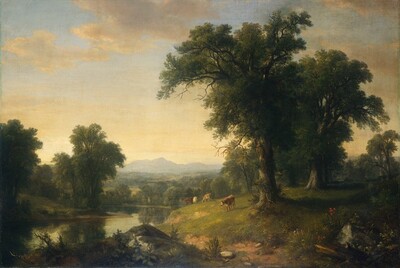
Asher Brown Durand (1796-1886) was a founder of the Hudson River School and its leading advocate for painting directly from nature. Pastoral Landscape from 1861 is a quintessential Durand composition: a peaceful valley with cattle, a meandering stream, and distant mountains, rendered with the topographic precision that distinguished his work from the more theatrical landscapes of Church and Bierstadt. The 1861 date places this in Durand's mature period, when his advocacy of 'nature first'—the principle that the artist should study nature directly rather than relying on studio conventions—had become the defining principle of the Hudson River School.
Cultural Impact
Durand's Pastoral Landscape participates in the tradition of idealized rural scenery that goes back to Claude Lorrain, but its topographic precision and its faithful rendering of American tree species and geological formations distinguish it from European precedents. The cattle, the stream, and the mountains are not generic pastoral elements but specific observations of the American landscape, recorded with the fidelity that Durand demanded in his famous 'Letters on Landscape Painting' published in The Crayon in 1855.
Why It Matters
Pastoral Landscape is Durand's Hudson River School creed made visible: a peaceful valley rendered with topographic precision rather than theatrical spectacle. The cattle, the stream, and the mountains are not pastoral conventions but American observations, painted with the fidelity to nature that Durand considered the landscape painter's highest duty.