
Provenance
Comtesse de Toulouse-Lautrec. M. Salavin, Paris.[1] Mr. and Mrs. Paul Mellon, Upperville, Virginia; gift 1994 to NGA.
[1]According to M.G. Dortu, _Toulouse-Lautrec et son oeuvre_, New York, 1971.
Accession Number
1994.59.14
Medium
oil on canvas
Dimensions
overall: 21.5 x 27 cm (8 7/16 x 10 5/8 in.) | mount: 27 x 32.5 cm (10 5/8 x 12 13/16 in.) | framed: 29.9 x 35.6 x 3.5 cm (11 3/4 x 14 x 1 3/8 in.)
Classification
Painting
Credit Line
Collection of Mr. and Mrs. Paul Mellon
Tags
Painting Impressionist & Modern (1851–1900) Oil Painting Canvas French
Background & Context
Background Story
Hussars (1878) is an early work depicting light cavalry soldiers—the hussars who were among the most glamorous units in European armies. Toulouse-Lautrec's choice of this military subject reflects his aristocratic origins: his family belonged to the landed nobility with deep military traditions, and the hussar regiment embodied the cavalry ideal that this tradition celebrated. The 1878 date places this when Toulouse-Lautrec was just fourteen—already drawing with the skill that would support his mature work but still under the influence of the military culture that shaped his family's identity. The hussars, with their distinctive uniforms—braided jackets, fur-lined pelisses, and the curved sabers that distinguished light cavalry—provided the young artist with figures of elegance and martial prowess that his own physical disabilities would prevent him from emulating. This irony—the aristocratic cavalryman painted by the artist who could not ride—gives the painting a poignancy that its conventional subject might otherwise lack. The hussars also connect to the broader European military tradition that was undergoing transformation in the late 19th century: the Franco-Prussian War had demonstrated that cavalry charges were increasingly vulnerable to modern weaponry, and the hussar's glamorous role was becoming historical rather than functional. Toulouse-Lautrec's painting thus documents a military tradition at the moment of its decline.
Cultural Impact
Toulouse-Lautrec's early military paintings influenced how the artist's aristocratic background was understood, documenting the military tradition that preceded his artistic career. The paintings influenced how European cavalry was represented in art, recording the hussar tradition at the moment of its historical decline. The hussars subject influenced how Toulouse-Lautrec's relationship to aristocratic culture was interpreted, connecting his later bohemian subjects to the military origins that he simultaneously rejected and preserved.
Why It Matters
This painting matters because it reveals the aristocratic military tradition that Toulouse-Lautrec came from—the world of hussars and cavalry that his physical disabilities prevented him from entering but that his art would preserve with the precision of someone who understood what he was missing. The painting's poignancy lies in the gap between the subject's physical grace and the painter's physical limitations.
Related Artworks
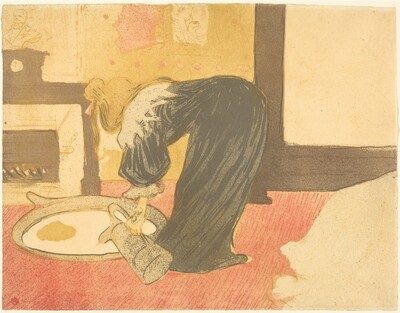
Woman at the Tub (Femme au tub)
Toulouse-Lautrec, Henri de

Guy and Mealy in "Paris qui marche" (Guy et Mealy dans "Paris qui marche")
Toulouse-Lautrec, Henri de
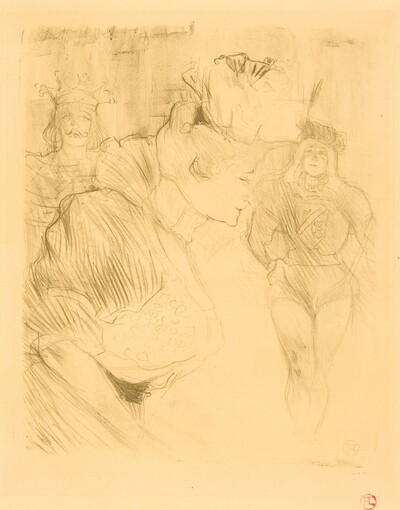
Lender Bowing (Lender saluant)
Toulouse-Lautrec, Henri de

Rejane and Galipaux in "Madame Sans-Gêne" (Réjane et Galipaux dans "Madame Sans-Gêne")
Toulouse-Lautrec, Henri de