Provenance
Winkler Collection, Dresden; Willy Dreyfus [1885-1977], Frankfurt and Montreux; his daughter, Lili-Charlotte Sarnoff [1916-2014], Bethesda, Maryland; gift (partial and promised) 1996 to NGA.[1]
[1] Provenance from curator's acquisition proposal, and Sarnoff collection records, in NGA curatorial files.
Accession Number
1996.64.1
Medium
oil on canvas
Dimensions
overall: 48.3 x 78.7 cm (19 x 31 in.) | framed: 63.18 x 94.3 x 6.03 cm (24 7/8 x 37 1/8 x 2 3/8 in.)
Classification
Painting
Credit Line
Donated by Lolo Sarnoff in memory of her grandfather, Louis Koch
Tags
Painting Neoclassical & Romantic (1751–1850) Oil Painting Canvas Italian Color: Yellow Color: Gold Color: White
Background & Context
Background Story
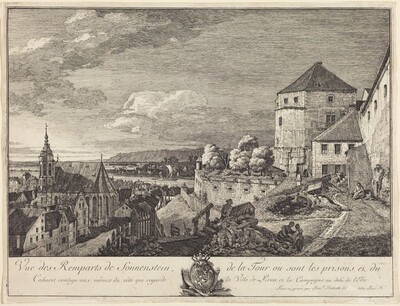
Bernardo Bellotto (1721-1780) was the nephew and pupil of Canaletto, known for his meticulously detailed topographic views of European cities and architectural monuments. The Fortress of Königstein, perched on a rocky outcrop near Dresden, was one of the most impressive military fortifications in Saxony, and Bellotto's painting of its courtyard demonstrates his ability to combine topographic accuracy with atmospheric subtlety. The Magdalenenburg (a building within the fortress) is rendered with the same precision that Canaletto brought to Venetian architecture, but Bellotto's cooler, more analytical style gives the scene a documentary quality that distinguishes his work from his uncle's more picturesque approach.
Cultural Impact
Bellotto's views of Königstein were commissioned by King Augustus III of Poland and Elector of Saxony, who wanted a comprehensive visual record of his territories. The Königstein paintings are among the most impressive examples of 18th-century topographic painting because they combine architectural precision with atmospheric depth—the fortress is both a document and a work of art, fulfilling the king's demand for accurate records while also satisfying Bellotto's artistic standards.
Why It Matters
The Fortress of Königstein: Courtyard with the Magdalenenburg is Bellotto's topographic precision at its most impressive: a Saxon fortress rendered with the documentary accuracy that Augustus III demanded and the atmospheric subtlety that Bellotto's artistic standards required. The fortress is both a military document and a work of art—an architectural record that is also a painting.