Provenance
Possibly Jacques Augustin de Silvestre [1719-1809], Paris; possibly (his estate sale, F.L. Regnault-Delalande, Paris, 28 February - 25 March 1811, no. 13, paired with _Return from Market_);[1] Laneuville. Godfrey von Preyer, Vienna. William Andrews Clark [1839-1925], New York; bequest 1926 to the Corcoran Gallery of Art, Washington; acquired 2014 by the National Gallery of Art.
[1] Paul Rosenberg, _Chardin_, exh. cat. Galeries nationales du Grand Palais, Paris; Kunstmuseum et Kunsthalle, Düsseldorf; Royal Academy of Arts, London; The Metropolitan Museum of Art, New York; Paris, 1999: 230, no. 53.
Accession Number
2014.79.708
Medium
oil on canvas
Dimensions
overall: 47 × 38.1 cm (18 1/2 × 15 in.) | framed: 62.23 × 53.34 × 9.53 cm (24 1/2 × 21 × 3 3/4 in.)
Classification
Painting
Credit Line
Corcoran Collection (William A. Clark Collection)
Tags
Painting Baroque (1600–1750) Oil Painting Canvas French
Background & Context
Background Story
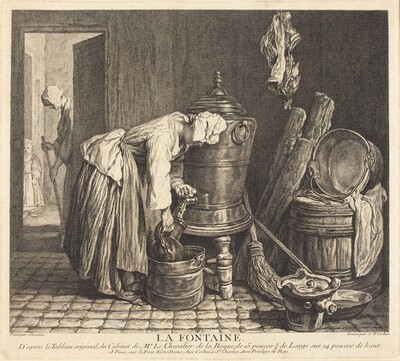
A companion piece to The Kitchen Maid, The Scullery Maid shows a servant woman at a copper washtub, surrounded by the implements of her labor — buckets, a water jug, a scrubbing brush. The painting is darker in tone than its companion, the light coming from a single window that illuminates the maid's face and the gleaming copper tub while leaving the rest of the kitchen in shadow. This dramatic chiaroscuro connects Chardin to the tradition of Dutch interior painting, particularly the work of Gerrit Dou, but the treatment is entirely his own: where Dou's surfaces invite admiration, Chardin's invite empathy.
Cultural Impact
Chardin's servant paintings were revolutionary in the 1730s not because they depicted working people — Dutch and Flemish genre had done that for centuries — but because they depicted them with the formal seriousness of history painting. The pyramidal composition, the controlled light, and the psychological depth of the maid's expression all belong to the visual language of high art, applied to a subject that the academic hierarchy considered low.
Why It Matters
The Scullery Maid is a twin to The Kitchen Maid, and together they form a diptych of working life that refuses to sentimentalize or patronize. Chardin sees these women clearly, paints them beautifully, and in doing so elevates their labor to the status of art.