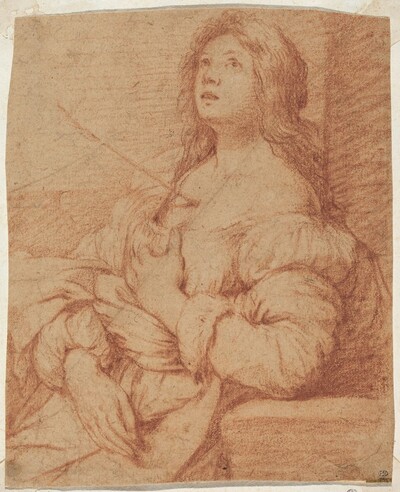
Provenance
(Carlo Sestieri, Rome); sold 1 August 1963 to Joseph McCrindle [1923-2008], New York; gift 2002 to NGA.
Accession Number
2002.78.1
Medium
oil on canvas
Dimensions
overall: 116.2 x 85.5 cm (45 3/4 x 33 11/16 in.)
Classification
Painting
Credit Line
Gift of Joseph F. McCrindle
Tags
Painting Baroque (1600–1750) Oil Painting Canvas Italian
Background & Context
Background Story
Bernardo Strozzi (1581-1644) was a Genoese painter known for his rich color and vigorous brushwork, combining the Baroque energy of Rubens with a distinctly Genoese decorative sensibility. Saint Francis in Prayer from c. 1620-30 depicts the Franciscan saint in one of the most important subjects of Counter-Reformation painting: Francis in ecstatic communion with God, his arms spread in a gesture of prayer and devotion. Strozzi's treatment combines the physical realism of the Baroque—Francis's weathered face, his rough habit, his muscular forearms—with the spiritual intensity of Counter-Reformation devotion.
Cultural Impact
Strozzi's Saint Francis participates in the Counter-Reformation tradition of depicting saints in ecstatic prayer, a subject that was central to Catholic devotional art in the 17th century. Strozzi's version is characteristically Genoese in its rich color and vigorous brushwork, combining the physical realism of the Baroque with the spiritual intensity of Counter-Reformation devotion. The weathered face and rough habit of Francis are rendered with the same vigor that Strozzi brought to secular subjects.
Why It Matters
Saint Francis in Prayer is Strozzi's Genoese Baroque at its most spiritual: the Franciscan saint rendered with physical realism (weathered face, rough habit, muscular forearms) and spiritual intensity (arms spread in ecstatic prayer). The c. 1620-30 date places this in Strozzi's most productive period, when his rich color and vigorous brushwork had achieved the balance between physical realism and devotional intensity that defines Genoese Baroque.