Provenance
Antoine de Cheneviere, Switzerland, in his family since the 19th century; purchased 21 March 2003 through (Hazlitt, Gooden & Fox, London) by NGA.
Accession Number
2003.41.1
Medium
oil on paper on canvas
Dimensions
overall: 40 x 52 cm (15 3/4 x 20 1/2 in.) | framed: 59.1 x 72.1 x 7.9 cm (23 1/4 x 28 3/8 x 3 1/8 in.)
Classification
Painting
Credit Line
Gift of Victoria and Roger Sant
Tags
Painting Neoclassical & Romantic (1751–1850) Oil Painting Canvas Swiss
Background & Context
Background Story
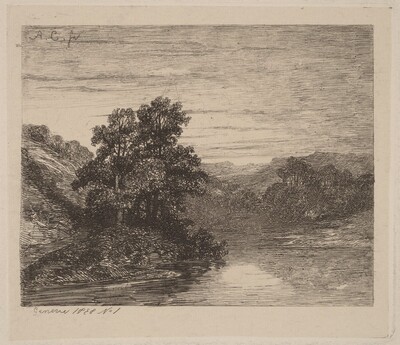
Alexandre Calame's "Swiss Landscape" (c. 1830) captures the sublime grandeur of the Alpine scenery that made this Swiss painter one of the most celebrated landscape artists of the nineteenth century. The painting presents a dramatic mountain vista — towering peaks, deep valleys, and the atmospheric effects of clouds passing over rugged terrain rendered with the precision and emotional intensity that defined the Alpine landscape tradition.
Calame (1810–1864) was born in Geneva and spent his entire career painting the Swiss Alps, becoming the definitive interpreter of Alpine scenery for European audiences. His paintings were exhibited in Paris, Berlin, London, and St. Petersburg, commanding enormous prices and winning him international fame. He was, in essence, the visual poet of the Alps — the artist who transformed Switzerland's mountains from geographic features into cultural symbols of nature's grandeur.
This early work from around 1830 shows Calame at the beginning of his career, already demonstrating the key elements of his mature style: meticulous observation of geological detail, dramatic contrasts of light and shadow, and a compositional structure that emphasizes the overwhelming scale of the mountains relative to the tiny human figures that often populate the foreground. The tradition of Alpine painting in which Calame worked had been established by earlier artists like Caspar Wolf, but Calame brought a new level of technical polish and emotional accessibility to the genre.
Calame's approach balanced scientific accuracy — he made extensive plein-air studies of rock formations, tree species, and cloud patterns — with Romantic sublimity. His mountains are simultaneously geologically convincing and emotionally overwhelming, appealing both to the naturalist's desire for accuracy and to the Romantic viewer's appetite for awe. This dual emphasis made his work enormously popular in an era when tourism was opening the Alps to a growing middle-class audience eager for landscape paintings as souvenirs of their travels, or as substitutes for travel they could not afford.
Cultural Impact
Calame's Alpine landscapes defined Switzerland's visual identity for international audiences and influenced the development of mountain landscape painting across Europe and America. His paintings helped create the modern perception of the Alps as symbols of nature's sublime power.
Why It Matters
This painting encapsulates Calame's dual achievement — combining geological precision with Romantic grandeur to create an image of the Alps that is both scientifically accurate and emotionally overwhelming.