Provenance
Purchased c. 1803 from the artist by Col. John Tayloe III [1771-1828], Mount Airy, Richmond County, Virginia; by descent to his son, Benjamin Ogle Tayloe [1796-1868]; by descent to his first wife, Phebe Warren Tayloe; gift 1884 to the Corcoran Gallery of Art, Washington; acquired 2014 by the National Gallery of Art.
Accession Number
2014.136.4
Medium
oil on canvas
Dimensions
overall: 74.3 x 61 cm (29 1/4 x 24 in.) | framed: 100 × 84.3 × 15.9 cm (39 3/8 × 33 3/16 × 6 1/4 in.)
Classification
Painting
Credit Line
Corcoran Collection (Bequest of Mrs. Benjamin Ogle Tayloe)
Tags
Painting Neoclassical & Romantic (1751–1850) Oil Painting Canvas American
Background & Context
Background Story
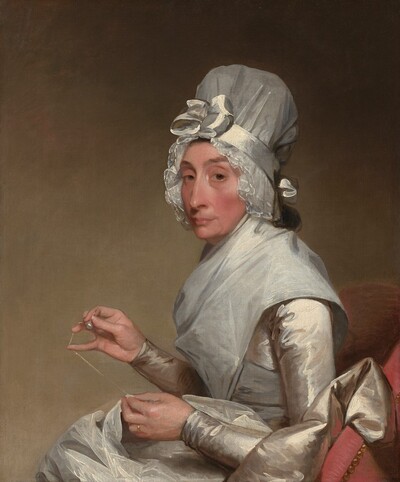
Gilbert Stuart's George Washington (c. 1803) belongs to the most famous portrait tradition in American art. Stuart painted Washington from life in 1795-96, and his three distinct types—the Vaughan portrait (Washington facing right), the Athenaeum portrait (Washington facing left, unfinished), and the Lansdowne portrait (full-length)—became the basis for over 1,000 replicas that Stuart and his assistants produced throughout his career. This 1803 version likely derives from one of these three life sittings, rendered with variations that reflect Stuart's commercial practice of producing Washington portraits for the eager American market. Stuart's Washington is the Washington that Americans have imagined for over two centuries: the firm mouth, the composed expression, the steady gaze that combines authority with republican simplicity. This image—Stuart's image—has shaped American political iconography more than any other visual source, determining how the nation's founding father is imagined from currency to textbooks to popular culture. By 1803, Washington had been dead for four years, and the young republic was navigating its first leadership transition. Stuart's Washington portraits served a political function: they provided a visual anchor for national identity during a period of political uncertainty, offering an image of presidential character that the new democracy could rally around.
Cultural Impact
Stuart's Washington portraits are arguably the most influential images in American art, shaping the national iconography of the presidency and the founding generation. The portraits influenced how presidential authority was visually represented, establishing conventions for depicting the chief executive that persist in official portraiture. The commercial success of Stuart's Washington replicas influenced the development of the American art market, demonstrating that national icons could generate sustainable artistic livelihoods. The portraits also influenced how republican virtue was visually defined—Stuart's Washington combined authority with accessibility in a way that defined American political identity.
Why It Matters
This painting matters because it created the visual archetype of the American president that persists to this day. Stuart's Washington is not merely a portrait of a specific individual—it is a portrait of an office and a political ideal. The composed expression, the steady gaze, and the republican simplicity of Stuart's presentation have defined how Americans expect their leaders to appear for over two centuries. For contemporary political culture, the painting offers a standard against which every subsequent presidential portrait has been measured.