Provenance
(Estate sale, Munich, 2003, as by an anonymous artist); private collection, Germany; (sale, Sotheby's, London, 15 June 2004, no. 26); (French & Company, Inc., New York); purchased 20 October 2004 by NGA.
Accession Number
2004.113.1
Medium
oil on canvas
Dimensions
overall: 35.3 × 49.1 cm (13 7/8 × 19 5/16 in.) | framed: 53.98 × 67.63 × 7.62 cm (21 1/4 × 26 5/8 × 3 in.)
Classification
Painting
Credit Line
Patrons' Permanent Fund
Tags
Painting Neoclassical & Romantic (1751–1850) Oil Painting Canvas German
Background & Context
Background Story
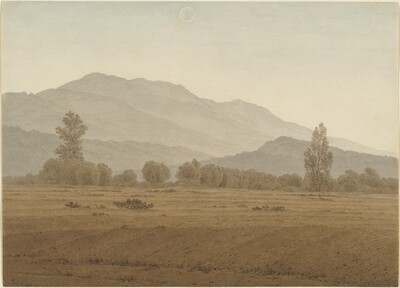
Caspar David Friedrich's "Northern Landscape, Spring" (c. 1825) captures the moment when the harsh Nordic winter begins to relinquish its grip and the landscape emerges into tentativenew life. The painting presents a view across a flat, watery terrain — likely the island of Rügen or the Elbe valley near Dresden, two landscapes that Friedrich returned to repeatedly — where bare trees and a pale sky signal the first arrival of spring after the long northern winter.
Friedrich (1774–1840) was the leading painter of the German Romantic movement and one of the most influential landscape painters in European art history. Born in Greifswald on the Baltic coast, he trained in Copenhagen before settling in Dresden, where he spent most of his career. Friedrich's landscapes are never mere depictions of scenery — they are vehicles for spiritual and emotional experience, in which nature serves as a mirror for the viewer's own interior life.
"Northern Landscape, Spring" belongs to a series of works in which Friedrich explored the seasonal cycle as a metaphor for the human lifespan. Spring, in Friedrich's visual vocabulary, represents youth, hope, and rebirth — the moment when life reasserts itself after the dormancy of winter. The painting's composition is characteristic of Friedrich's approach: the viewer stands on elevated ground looking across an expansive vista, with the foreground framing devices (trees, rocks, or in this case, the edge of a hill) creating a sense of being positioned within the landscape rather than observing it from outside.
The painting's restrained palette — muted greens, soft browns, and a luminous pale sky — creates an atmosphere of hushed anticipation. Friedrich avoids the vibrant colors that conventionally signal spring, instead suggesting the season through subtler cues: the loosening of bare branches, the greening of the lower vegetation, the clearing of the sky. This approach reflects Friedrich's profound understanding that the most powerful experiences of nature are often the quietest — not the dramatic sunset or the thunderstorm, but the gradual realization that the world is coming back to life.
Friedrich's influence on European art was immense but delayed. During his lifetime, his paintings were admired by a small circle of like-minded Romantics but dismissed by the academic establishment. It was not until the twentieth century that Friedrich was fully recognized as a major artist, when his emphasis on subjective experience and the spiritual dimension of nature resonated with modernist and existentialist thought.
Cultural Impact
Friedrich's vision of landscape as a mirror of inner experience influenced European art from the Romantics through the Symbolists and into modern abstraction, fundamentally changing how artists and viewers understood the relationship between nature and emotion.
Why It Matters
This painting transforms the arrival of northern spring from a seasonal event into a spiritual experience — Friedrich's meditation on hope, rebirth, and the quiet persistence of life after winter's long dormancy.